

SCOPE
Seller growth ecosystem across lifecycle stages
NATURE
Independently launched, strategically sequenced rollout
TEAMS
Product · Design · Research · Engineering · L10n
CONTEXT
By 2021, Pinkoi's seller ecosystem had grown to include tens of thousands of creative brands. Its competitive advantage came from what competitors couldn't easily replicate: a curated community offering unique, design-forward products.
These independent designers and makers were the platform's long-term moat, setting Pinkoi apart from larger, commodity-focused marketplaces.
We had built seller support over the years. Designer Relations teams earned sellers' trust through meetups and workshops. My design and content teams created seller handbooks and seller stories.
The seller ecosystem looked healthy. New sellers joined steadily, and the community felt vibrant. But underneath the growth numbers, sellers were losing confidence, drifting away quietly despite available resources and support.
The differentiation that made Pinkoi defensible depended on sellers who could build sustainable businesses and stay. Without them, that advantage was at risk.
The Challenge
What mattered to me was building a thriving seller community. Not every seller would achieve the same success since everyone's journey differed, but a healthy ecosystem meant sellers were making progress toward their goals, even at different speeds.
As we scaled, three pressure points appeared.
Manual support couldn't scale.
Designer Relations teams built genuine relationships through meetups and personal guidance, but this approach had natural limits. As seller numbers grew, the team's capacity didn't. We were choosing between shallow support for many or deep support for few, and neither option solved the fundamental problem.
We lacked a framework to understand seller health at the ecosystem level.
We could assess individual sellers, but we couldn't see the bigger picture: whether distribution was healthy across seller stages, which segments were struggling, or where systemic problems were emerging. We risked building for visible pain points instead of underlying issues.
Feature requests multiplied.
The wishlist kept growing, but every seller segment had different needs, and each addition served only a fraction of the base.
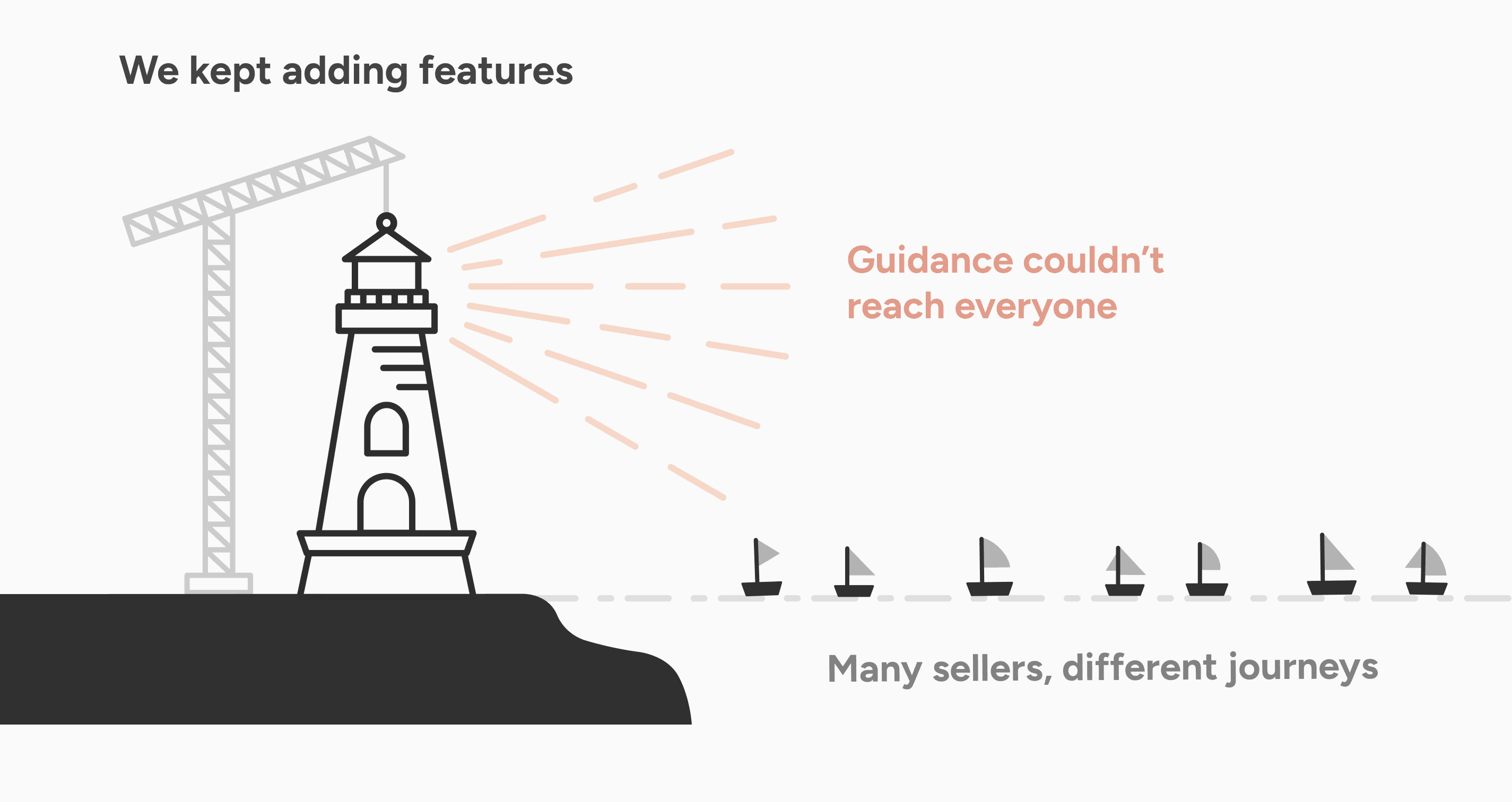
The default path was appealing: requests were concrete, and shipping felt like progress.
But I wondered if there was a different way to think about the problem. With such a diverse seller base, would more features create clarity or just more complexity? Would we end up building solutions sellers couldn't figure out how to use?
The challenge wasn't what to build. It was finding an approach that could scale while adapting to each seller's journey.
SPIDEY SENSE
I understood sellers in a way that went beyond data.
Having been one myself, I navigated the full complexity of running a small business: online marketplaces, art shows, consignment deals, managing my own site. The uncertainty was familiar: the self-doubt, the loneliness of not knowing if you are doing it right, the invisible struggles that never made it into feedback forms.
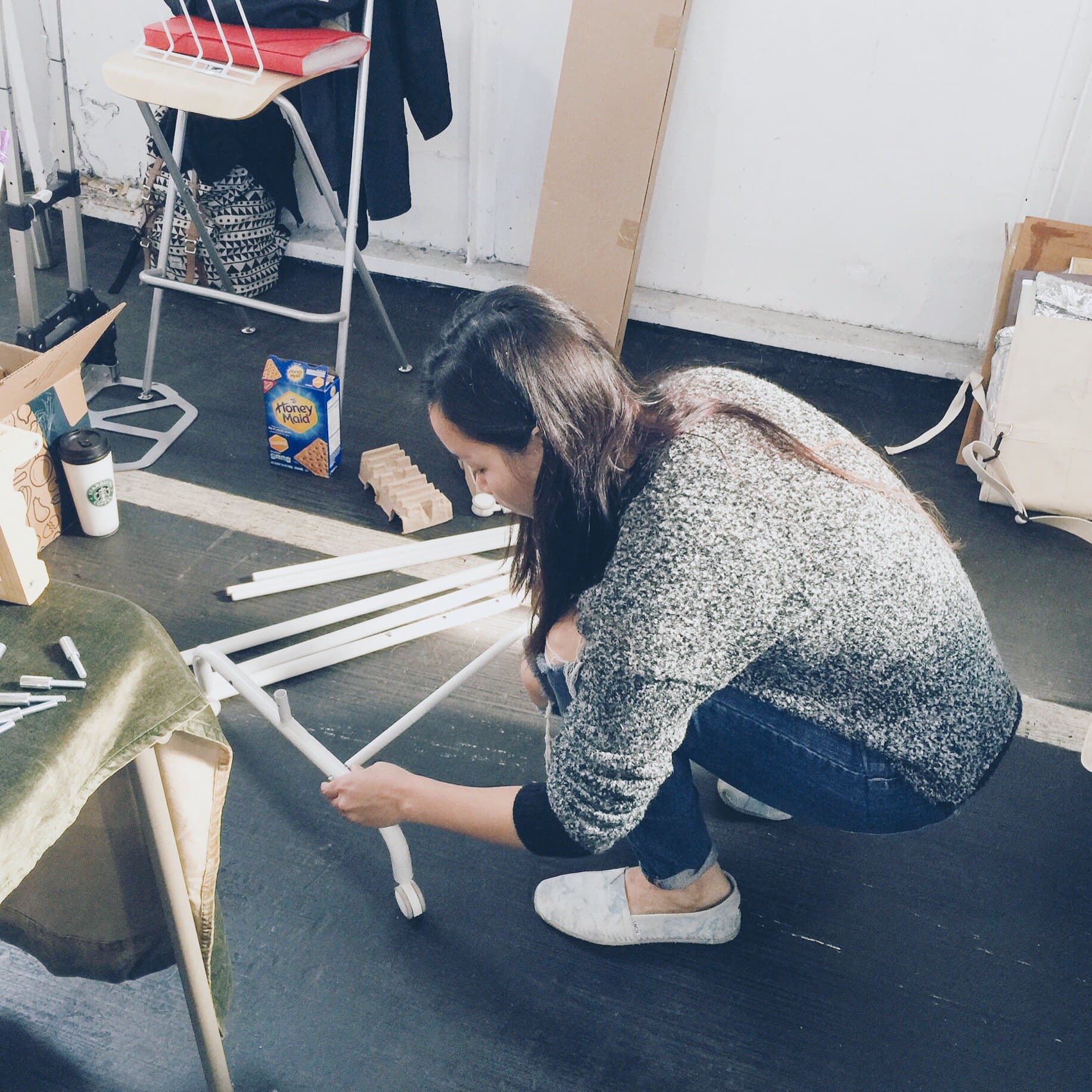

Years of conversations with Pinkoi sellers also taught me to read between the lines, hear what was not being said, and sense when someone was struggling even when they did not ask for help.
Watching sellers navigate the pandemic deepened this. From pre-COVID stability to COVID disruption, I could see the toll: cross-border delivery disrupted, offline events canceled, buyer demand dropping. Post-COVID would bring another shift entirely. Each wave required sellers to adapt again.
I wanted to preempt problems before they showed up. The question that stayed with me: what could we build that would help them navigate not just today's uncertainty, but whatever came next?
From hypothesis to evidence
This urgency made one thing clear. We had data, but the patterns within it remained unread. The invisible had to become visible, translating observations into evidence that could build organizational conviction.
I pushed for comprehensive seller research. Our researchers conducted 12 in-depth interviews and surveyed 2000+ sellers to understand their struggles. More critically, our data scientists analyzed seller cohorts and progression patterns to see where growth was stalling.
THE DISCOVERY
No single solution fits
The interviews revealed what the numbers could not.
A jewelry maker running her business part-time had completely different challenges than an established homeware brand managing multiple channels. A new seller launching their first product needed different support than an experienced maker expanding to international markets.
Struggles were universal, but each seller's path was distinct.
Tools existed. Understanding didn't.
When survey results came in, a clear pattern surfaced.
Around 30% didn't know where they stood or if their efforts were working. Nearly a quarter struggled with marketing, either not knowing where to start or unable to improve despite trying.
Over 20% felt buried in competition, invisible among thousands of products.
Sellers had access to tools but didn't know how to use them effectively. These knowledge gaps manifested differently depending on where sellers were in their journey, what kind of business they ran, and how they operated.
Four dimensions, countless combinations
The variety came from 4 factors.
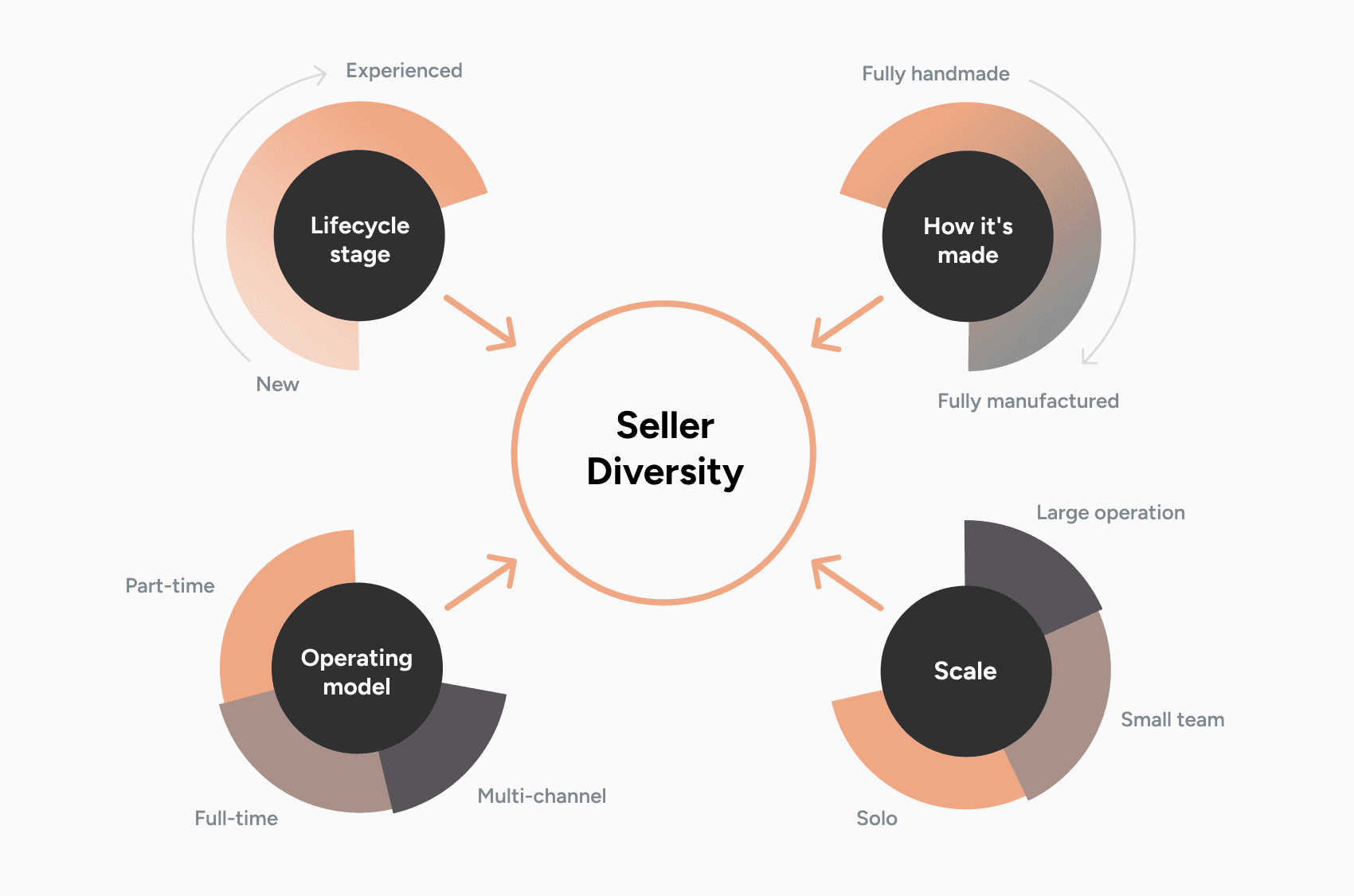
Sellers differed by lifecycle stage. New sellers needed to learn how to sell. Experienced sellers needed to learn how to scale.
They differed by scale. A solo seller, a small team, and a larger operation each required different infrastructure to function effectively.
They differed by how products are made. Some sellers crafted everything from raw materials by hand. Others combined handwork with sourced components or machinery. Some designed products fully manufactured in factories. Each point on that spectrum came with different production realities and platform needs.
They differed by operating model. Part-time sellers juggling other commitments, full-time sellers focused on a single channel, and multi-channel brands managing complexity across platforms operated in completely different contexts.
When combined, these factors created paths so different that no single solution could serve them all.
We couldn't patch our way to scale
This explained why our previous approach wasn’t working. We had been building features for the largest pain points, focusing resources on what affected the most sellers, letting smaller segments find workarounds.
Even within our largest segments, sellers differed too much for one-size-fits-all solutions. The number of smaller segments, each struggling to adapt existing tools, was too large to ignore.
For Pinkoi, this required a different approach. Our positioning as a curated design platform meant seller quality directly shaped platform quality. We had chosen to build a brand around unique, high-quality sellers rather than infinite supply. We needed sellers to stay and succeed, not just join and drift away.
The insight shifted our strategy. A different question emerged:
How might we help sellers help themselves at scale?
DEEPER INSIGHTS
When success stayed at the top
Understanding what sellers struggled with wasn't enough. We needed to see where growth was actually breaking down, which sellers were stuck, and why they could not move forward.
The research revealed an ecosystem with concentrated success and widespread struggle.
The long tail wasn’t growing
Most sellers weren't succeeding. When we analyzed seller performance across revenue, reach, and traffic patterns, the difference was significant: Revenue was concentrated among a small group of established sellers. The majority were still building their businesses, with potential but no clear path forward.
Our growth pattern analysis went deeper, examining sellers who joined in the past six months. What we found:

45% had never made their first sale
33% achieved only sporadic orders, technically 'active' but losing confidence with each passing month of minimal sales
16% showed gradual improvement, selling 1-2 orders on good days
Only 5% showed healthy patterns: consistent orders, multiple sales per day
Where momentum broke down
Previously, I had visualized the seller lifecycle as three interconnected loops to help the team understand seller growth phases. When we mapped the findings onto this framework, it revealed where sellers were failing.
Most got stuck in the middle retention loop. They would join, make their first few sales, but then couldn't build momentum. When success remained inconsistent, confidence dropped, and they either became inactive or shifted focus elsewhere.
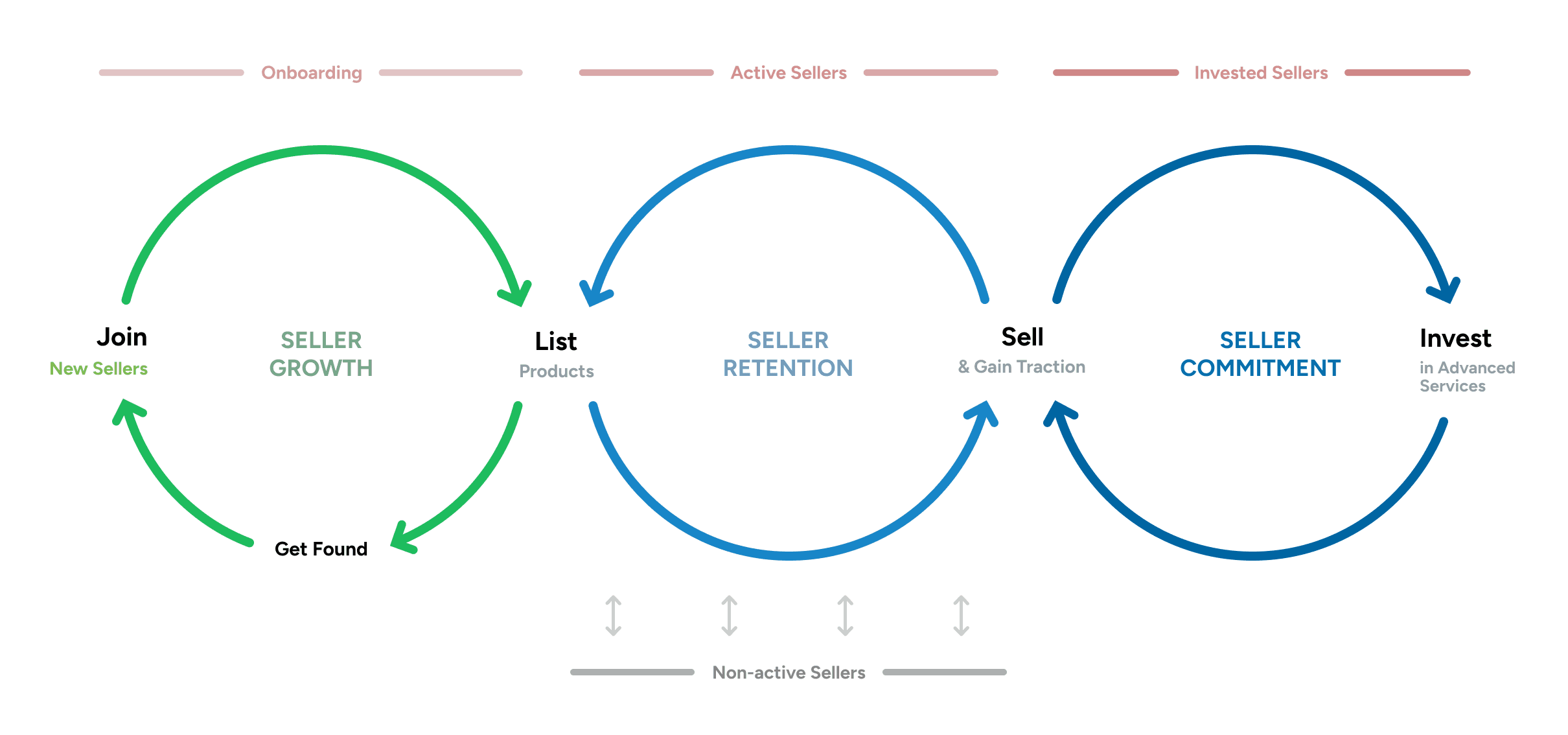
The loops showed where sellers failed. The next question was why.
Signal lost in the noise
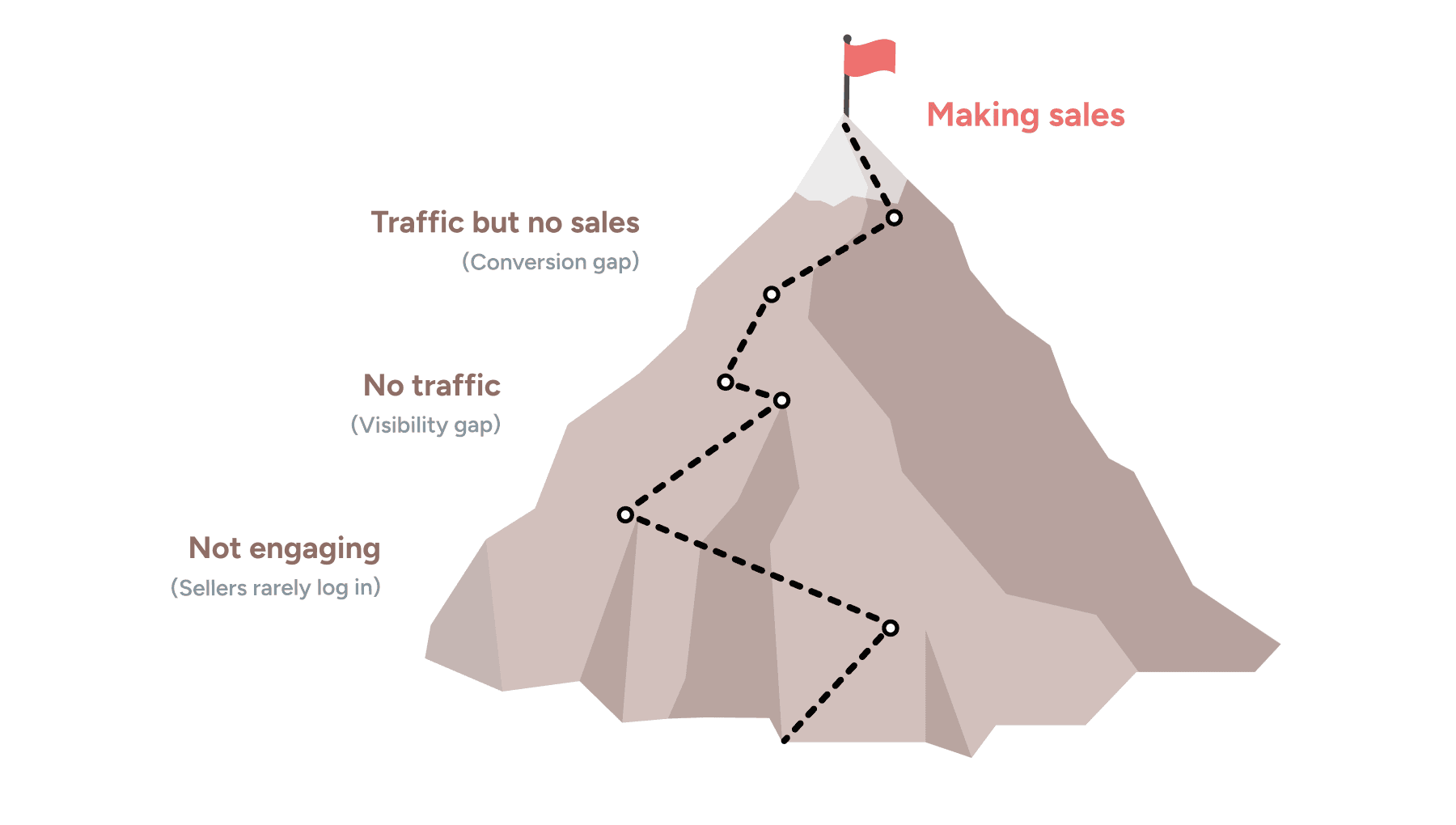
Analyzing seller progression made it clear: 31% rarely logged into Shop Manager or engaged with available tools.
It was a catch-22: not knowing where to start kept them away. Staying away meant they never learned what actions would make a difference.
Another 2% showed up consistently but their products weren't being seen. They were actively trying, but couldn't figure out how to break through the noise.
6% received decent traffic but still couldn't convert visitors into buyers. They lacked insights to understand what was working or how to improve.
Across all these stages, sellers faced the same challenge: they couldn't determine what to prioritize. The platform provided tools, but sellers couldn't distinguish signal from noise. They were putting in effort, but it wasn't compounding into results.
STRATEGIC APPROACH
Getting the sequence right
Choosing capability over features
Nearly 40% of sellers had clear progression blockers, not from lack of tools, but from not knowing how to translate those tools into results. More features wouldn't solve this. They needed guidance systems that could adapt to their situations and help them help themselves.
I focused the enablement team on building that capability.
This was the harder choice. It meant investing in systems that wouldn't show immediate returns, building for sellers who might never succeed or might leave regardless, and resisting internal pressure to chase visible wins.
But it was the only path that addressed the root problem. Without this foundation, the platform couldn't unlock potential across most of our seller base or sustain long-term health.
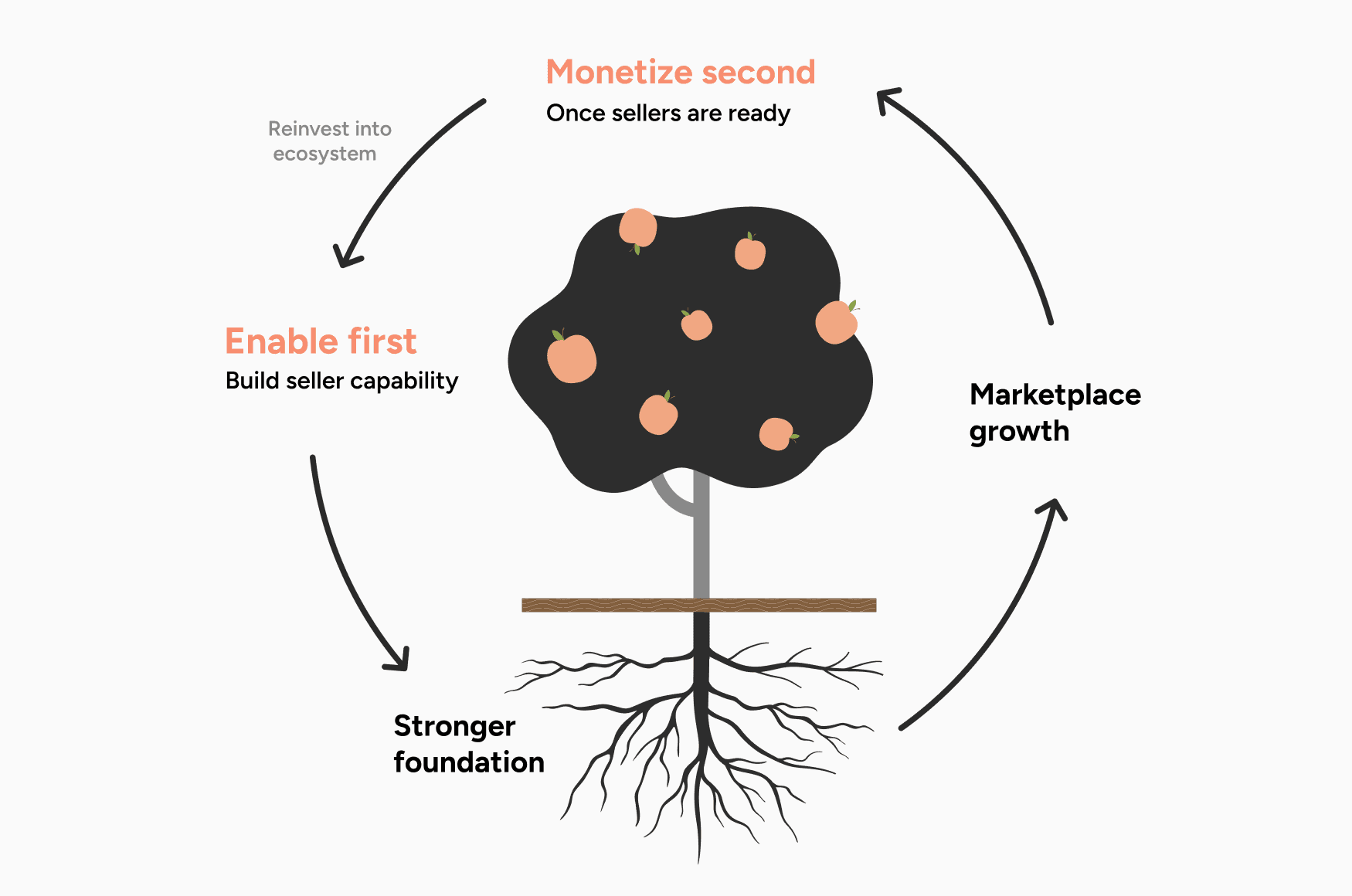
While the enablement team built infrastructure, monetization required a different approach. We needed to let revenue follow seller success. I kept monetization selective, but still delivered results.
When we did build monetization features, enablement infrastructure strengthened their impact.
Research insights from enablement work informed which monetization features to prioritize. Guidance systems built by enablement also helped sellers understand how to use Ads and other paid services better, improving adoption and effectiveness.
Enablement and monetization amplified each other.
SOLUTION
From tools to seller capability
The strategy centered on building two types of infrastructure simultaneously: enablement systems that scaled guidance across diverse seller needs, and selective services for sellers ready to invest more.
Guidance that scaled with sellers
We built three components that formed a continuous learning loop across the seller journey.
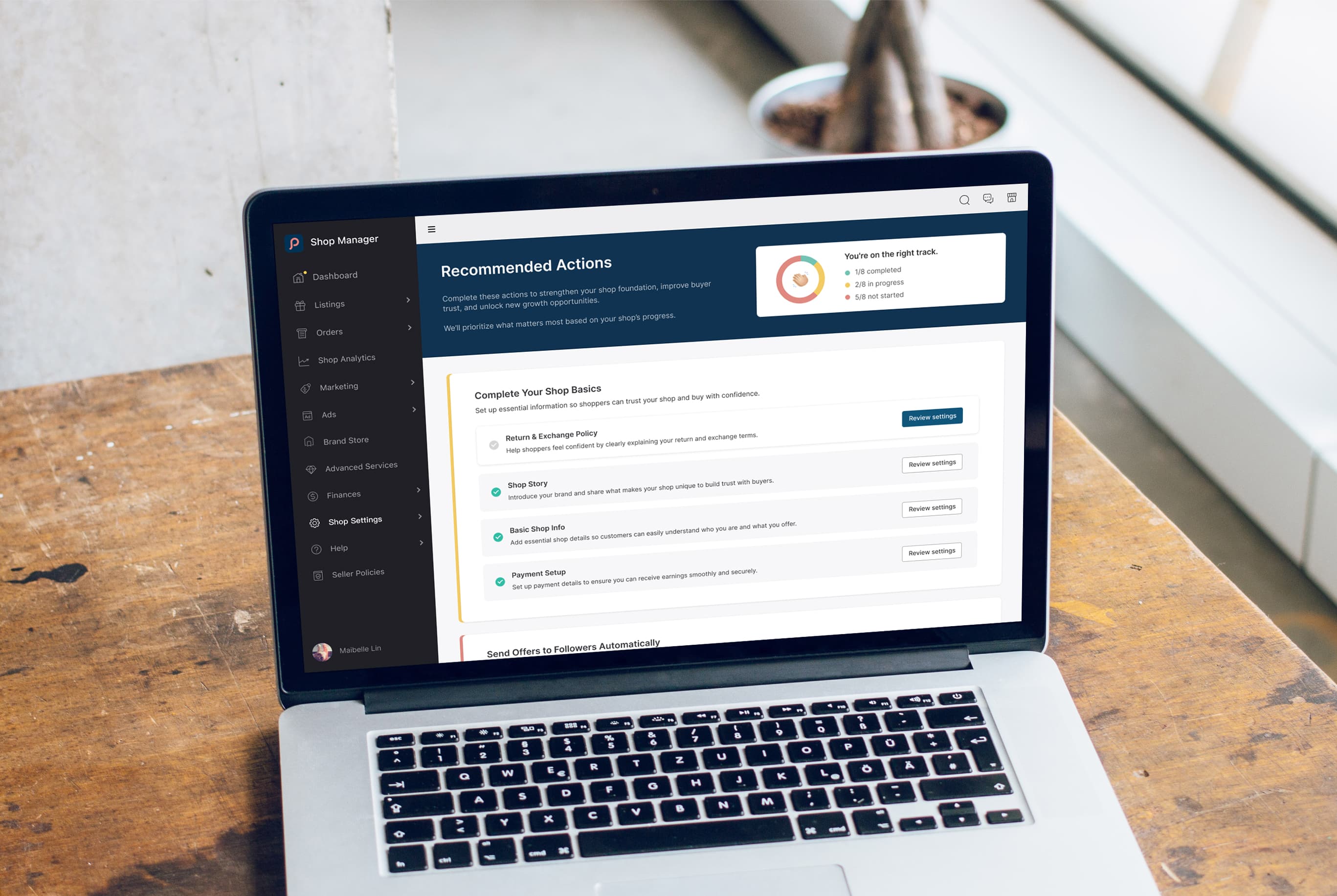
Progressive Growth Actions gave sellers structure when uncertainty was highest. New sellers faced overwhelming setup with no clear priorities. We broke onboarding into milestones from basic setup to cross-border expansion, so sellers could see where they stood and what came next.
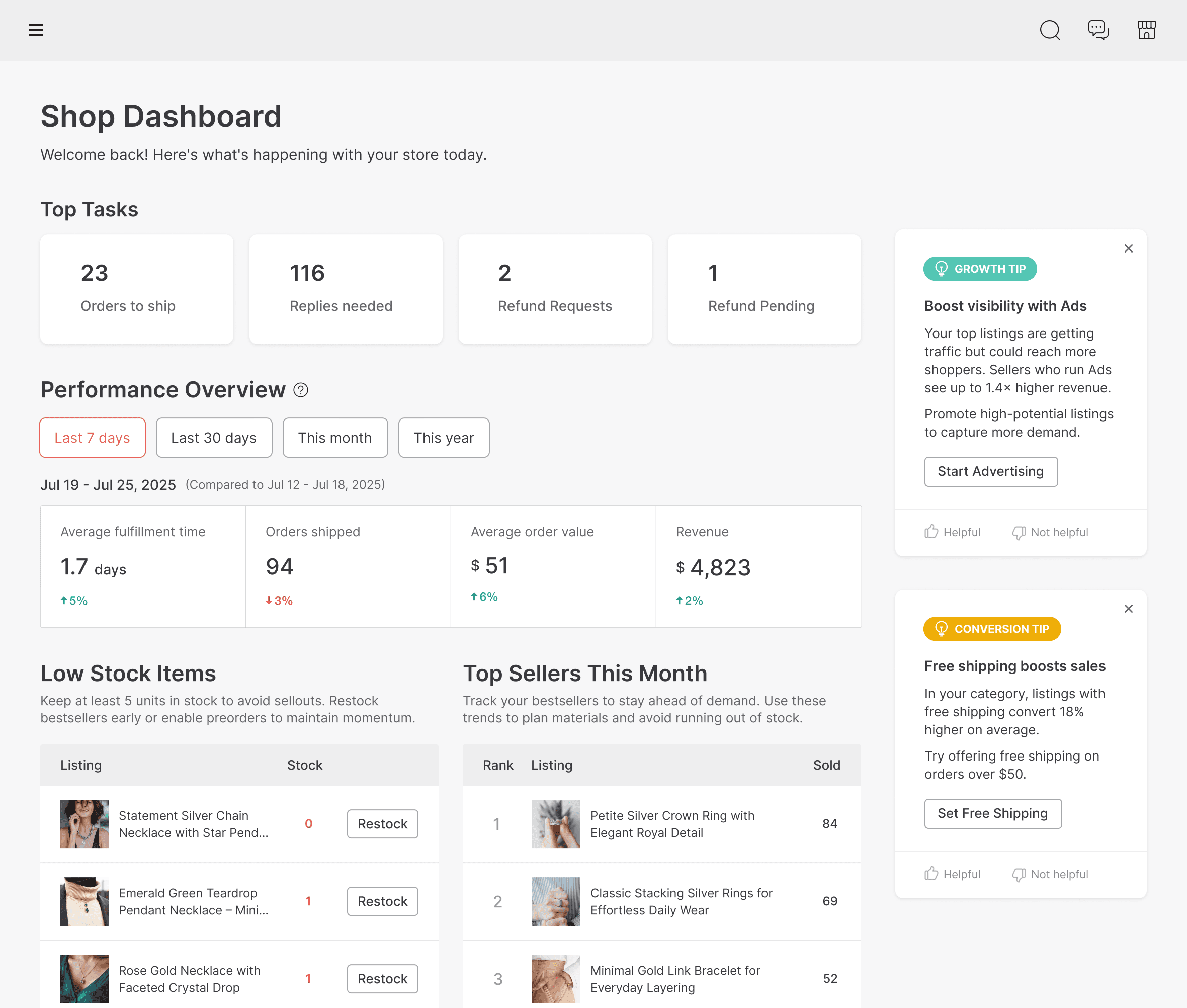
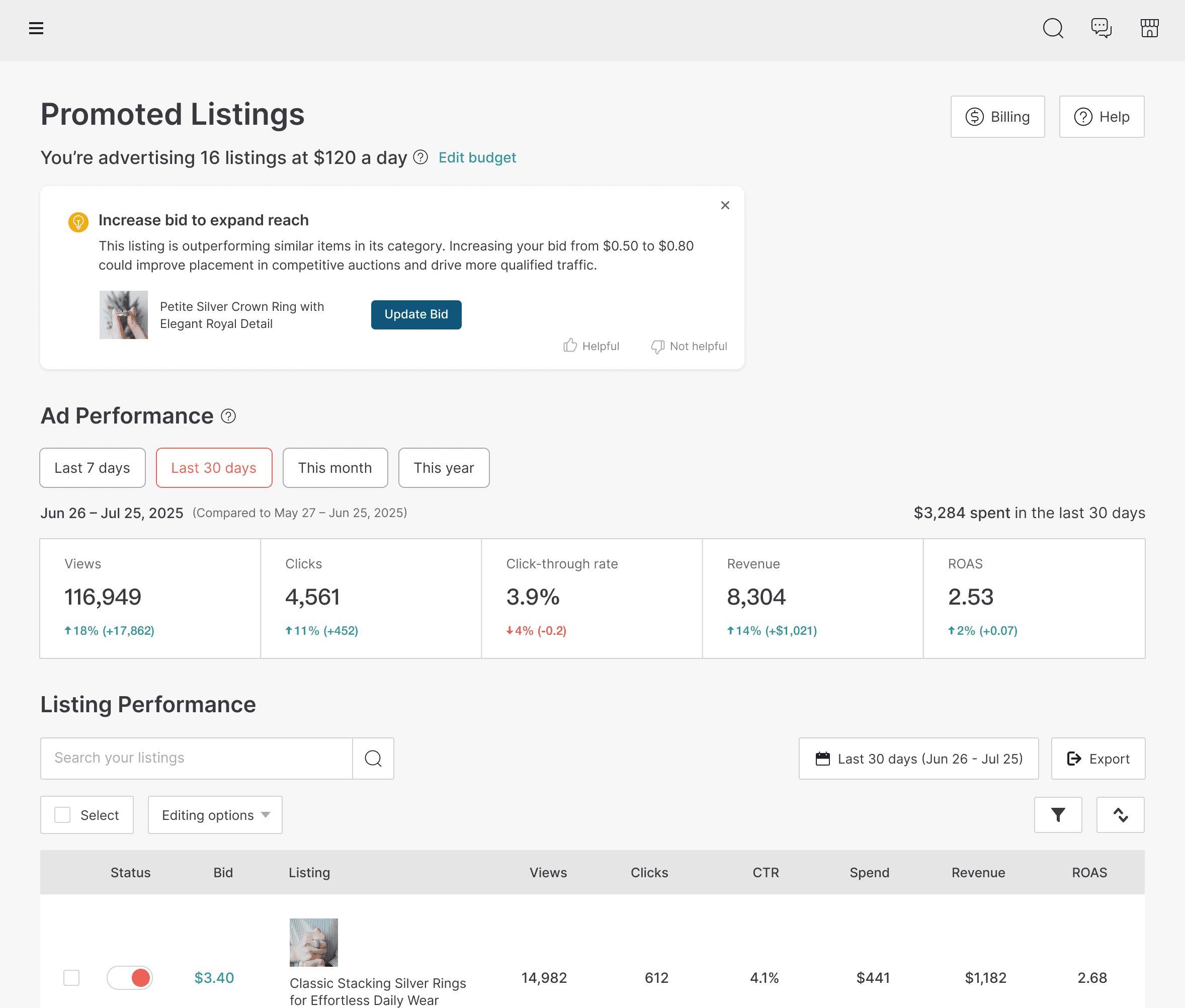
Guidance system across dashboard and Ads workflows
What began as a lightweight advertising optimization experiment using Guiding Tips evolved into a modular automation layer spanning campaign activation prompts, bid recommendations, budget alerts, and performance diagnostics.
By 2023, the system could surface condition-based suggestions across workflows, adapting guidance to seller maturity and campaign performance.
The underlying logic remained consistent: detect meaningful signals, translate them into clear actions, and reduce hesitation at the moment of decision. The interface evolved, but the behavioral model scaled across teams and use cases.
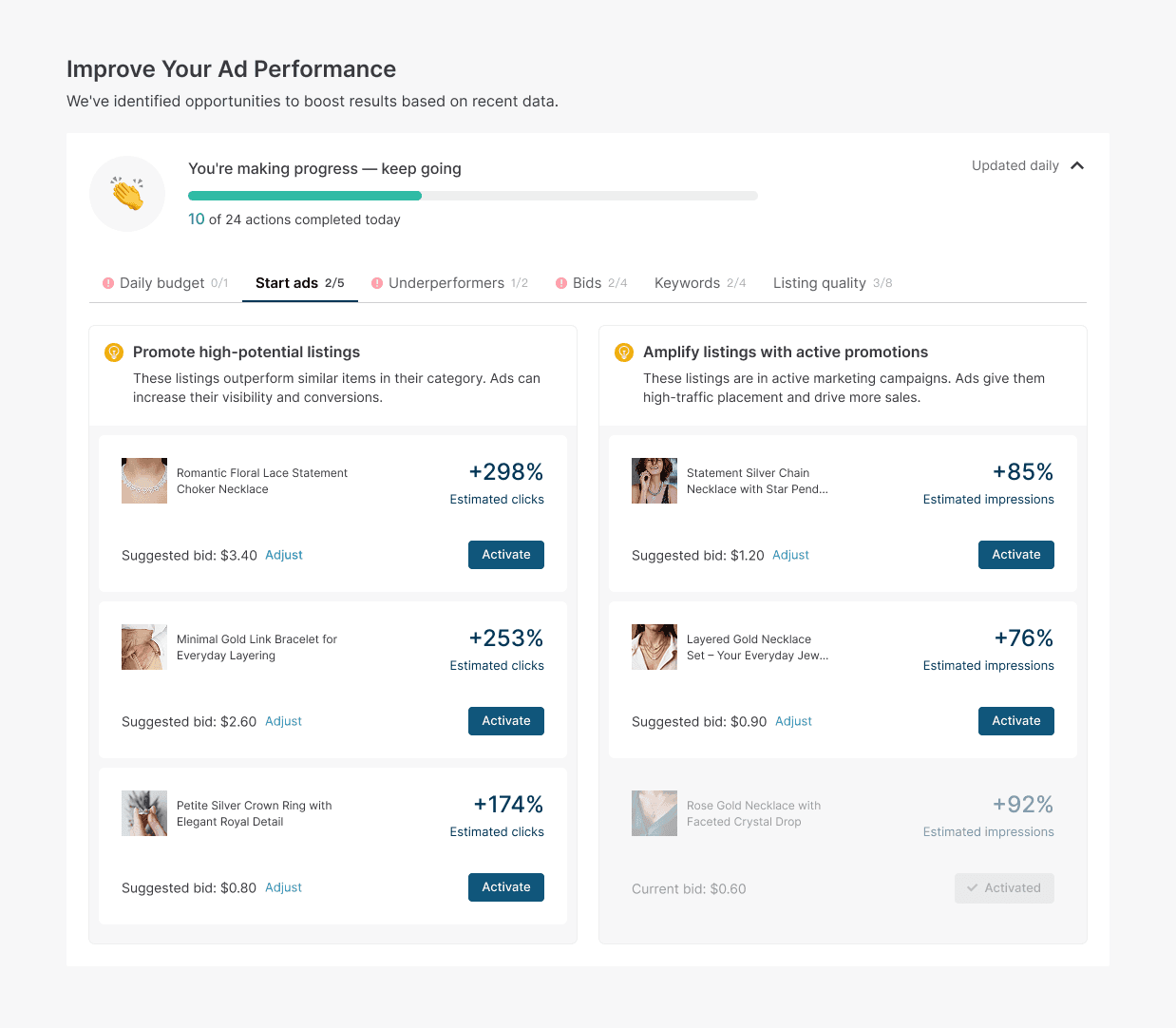
Later iteration of the guidance module integrated into seller campaign workflows
Guidance helped sellers act, but action without feedback didn't build confidence. Once sellers began trying new behaviors, they needed a way to tell whether those efforts were working. Shop Analytics existed to close that loop.
Shop Analytics consolidated fragmented metrics into a single view, helping sellers develop consistent monitoring habits. Rather than updating everything daily, we varied refresh rates. Some metrics were updated hourly, others daily or weekly, creating natural check-in rhythms instead of one-time visits.
Metrics alone weren't enough. Without attribution, improvement stayed accidental rather than repeatable. We broke down traffic sources so sellers could see both their own impact and Pinkoi's contribution.
Internal sources showed how buyers found and engaged with their shops: through search, browsing and interactions, AI recommendations, and featured placements.
External sources showed Pinkoi's marketing bringing new attention to shops. Each came with contextual guidance showing what was working and what to adjust next.
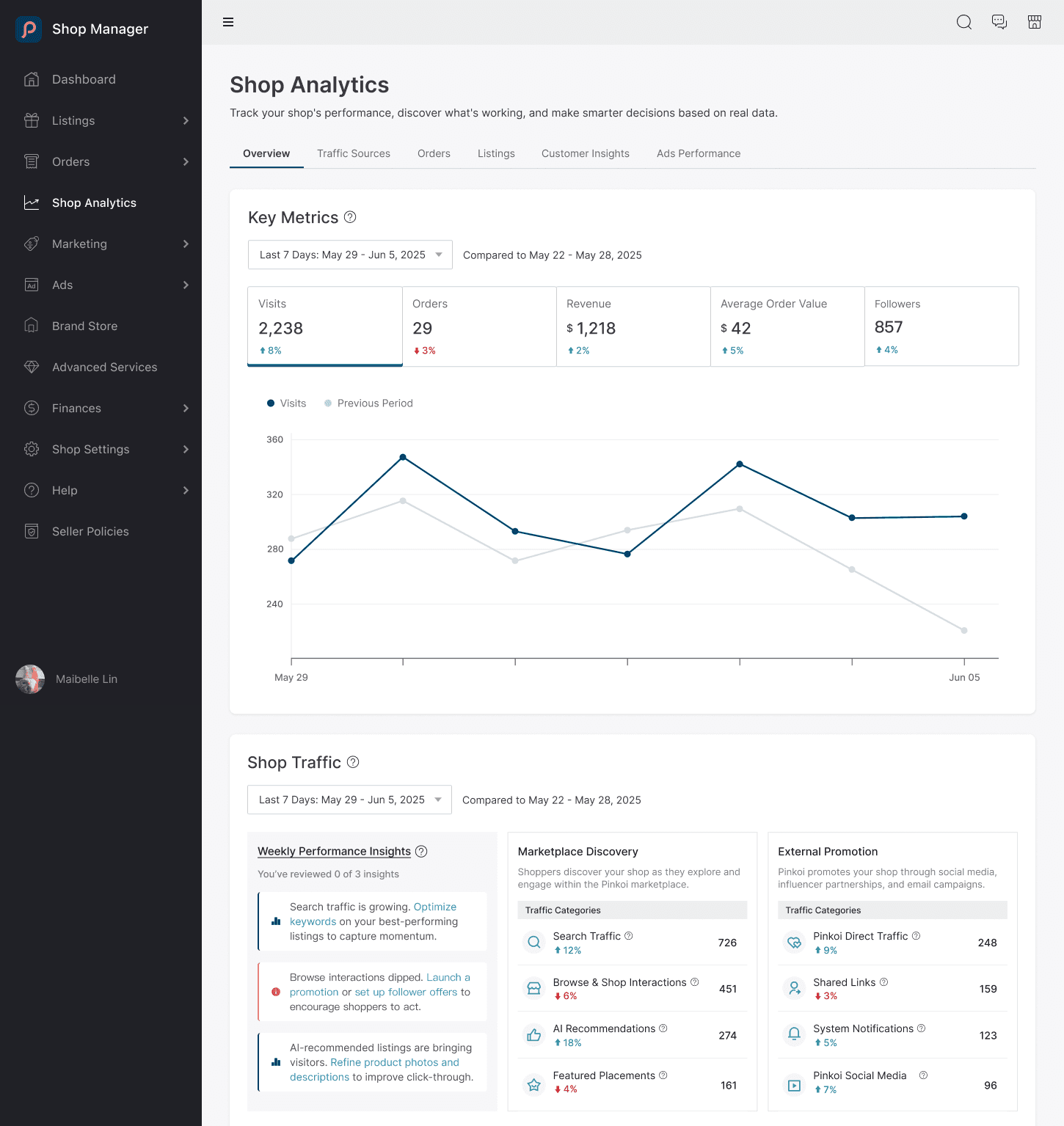
Structure showed what to do, guidance prompted next steps, and analytics confirmed impact. Each component strengthened the others and adapted to sellers wherever they were.
This enabled us to address monetization differently.
Revenue built on readiness
Ads were already generating revenue, and pressure existed to accelerate paid offerings more aggressively.
Scaling monetization without a broader base of ready sellers would quickly hit a ceiling. The sellers who could immediately benefit from advanced services were limited, and building ahead of readiness would have limited adoption now and long-term growth.
Instead of asking what could generate revenue fastest, we asked a different question: Which seller problems were becoming solvable at scale, and which were not yet?
By this point, early signals were emerging. More sellers were engaging frequently with Shop Manager, checking analytics, and acting on timely guidance. Selective monetization became viable.
We validated this through research before building anything. Surveys and in-depth interviews tested three potential services: Advanced Analytics, Targeted Messages, and Custom Landing Pages.
Advanced Analytics showed strong interest, but the free Shop Analytics baseline we had established met most sellers' needs. Only a small segment required deeper functionality. The addressable market was narrow, with limited revenue potential. We chose not to pursue it.
Targeted Messages revealed a different pattern. Interest remained high, willingness to pay held across seller tiers, and the service aligned with behaviors sellers were already beginning to adopt.
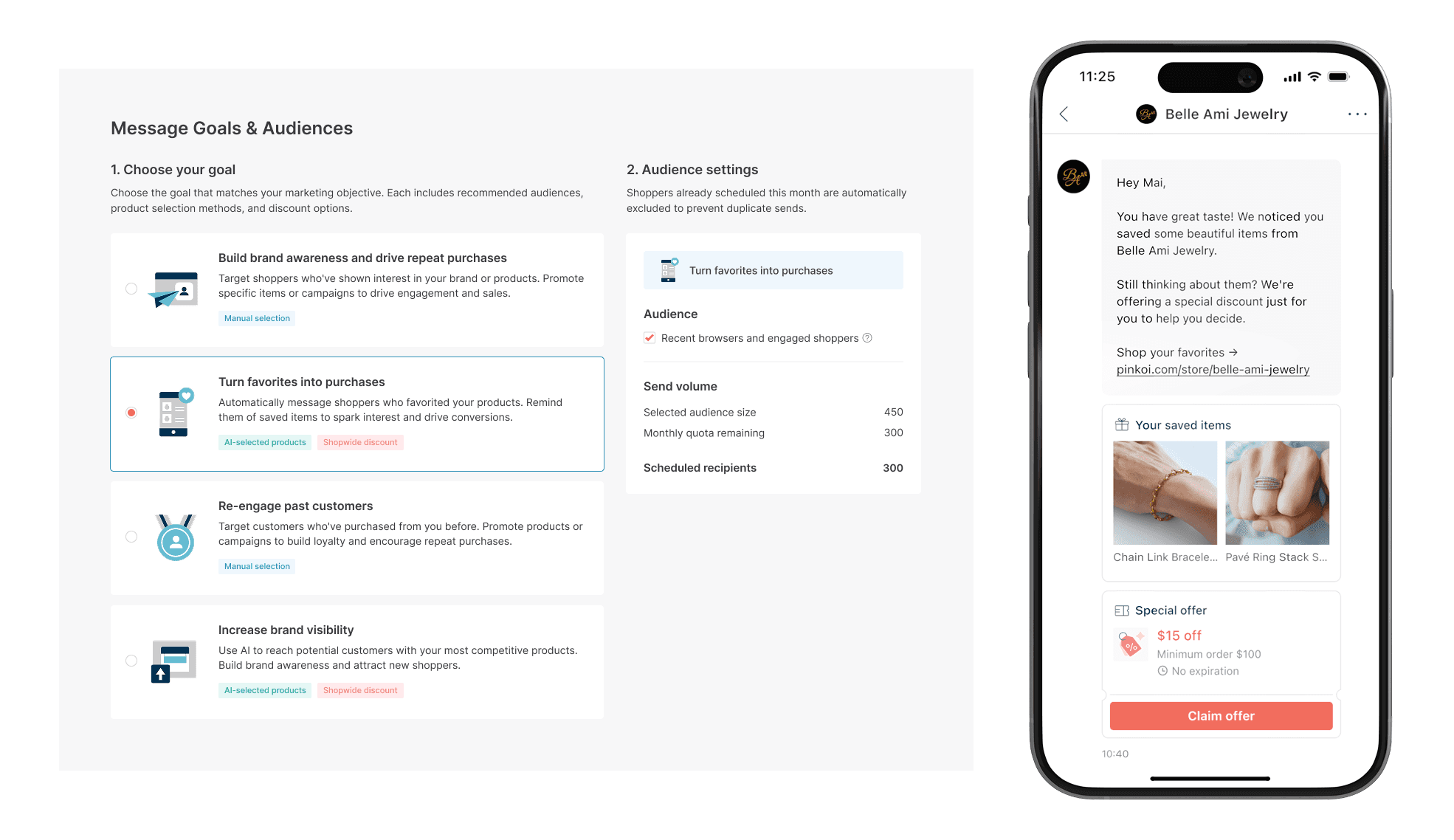
Goal-driven customer outreach with personalized messaging
Sellers described frustrations around customer communication: no way to reach different customer groups, and no control over how coupons were distributed.
Targeted Messages addressed both. Sellers could select a goal (driving purchases, re-engaging dormant customers, increasing awareness) and the system generated appropriate audience segments and message templates automatically, inserting buyer names, relevant products, and coupons by default.
Custom Landing Pages addressed a different execution constraint. Sellers saw opportunities for seasonal campaigns, product launches, and promotional events, but lacked the design and engineering resources to execute quickly.
With Custom Landing Pages, sellers could launch campaign pages using modular templates with banners, featured products, coupons, and media, without design or engineering support.
Whether creating campaign-specific promotions or in-depth brand storytelling, they could launch in minutes, not weeks.

Build campaign and brand pages without design or engineering support
How enablement and monetization compounded
Shared infrastructure created leverage. Rather than building separate systems, we designed modular frameworks both teams could use. The Guiding Tips infrastructure started with Ads optimization, then extended to seller guidance.
Research efforts informed both roadmaps simultaneously. One survey testing Targeted Messages interest revealed feature priorities for monetization and guidance needs for enablement.
The sequence mattered. Enablement built the foundation. Monetization followed readiness, not the reverse.
Enable first. Monetize second.
Results
What enablement made possible
System impact
The enablement infrastructure created a reinforcing cycle of engagement.
Sellers who engaged with one component naturally moved to the next. Those who completed Growth Actions milestones began responding to Guiding Tips. When they acted on suggestions (setting up coupons, adjusting listings), they checked Shop Analytics to see if it worked. Then they returned for more guidance.
The pattern was visible in behavior data. Guiding Tips proved 4x more effective than push notifications because sellers saw them in context, at the moment decisions mattered. When 10% took immediate action, they came back to check the results. Shop Analytics visits climbed 41% as sellers developed monitoring routines. Sporadic check-ins became consistent habits, with some returning 5–6 times daily.
For sellers just starting out, the impact was immediate: 17% activity increase in the first week. The most striking validation came from dormant sellers. Those who had been inactive for over five months returned after viewing their analytics and began listing products again.
Seller validation
Sellers described the shift in their own words:
"Being able to see how my traffic broke down helped me understand what was actually working in my shop. It gave me a clearer picture of my overall performance."
“Most of my keywords weren't being searched at all. The suggestions showed me what to use instead, and my search ranking improved so much after that.”
"Checking Shop Manager daily and making adjustments based on what I saw started showing results after a while. That momentum made me want to keep investing effort."
"The suggestions were straightforward. I just had to decide if they made sense for my shop. I didn't have to figure everything out on my own anymore, which saved so much time."
Each seller found a different way in, but the shift was the same: less guessing, more acting on what they could actually see.
Ecosystem impact
Advanced Services launched when enough sellers had crossed the capability threshold.
Hundreds of sellers subscribed in the first month. Monthly recurring revenue reached five figures within the first quarter. Sellers who actively monitored Shop Analytics were significantly more likely to subscribe to Advanced Services and retain.
But the infrastructure's value extended beyond these subscriptions. Enablement improved adoption across all seller services.
The same Guiding Tips framework that helped sellers set coupons also helped them optimize advertising. Research conducted to validate Targeted Messages simultaneously revealed which seller segments needed which types of support.
By 2023, the seller services ecosystem had grown to ~10,000 monthly subscriptions with ~90% retention, contributing over 30% of platform revenue.
What this unlocked
Enablement changed the quality of growth.
Sellers who developed operational habits made better decisions. They understood what drove traffic, how conversion shifted, and when paid services could accelerate results. Monetization became an extension of competence, not a substitute for it.
By shifting from feature releases to capability building, Pinkoi evolved from supporting individual sellers to building an ecosystem where sellers and platform grew together.
A final note
None of this would be here without Seller Service and Paid Service Squads.
Having stood on both sides, as someone who once didn't know if the effort was worth it, and as someone who got to help answer that question at scale, this one stayed with me.