SCOPE
Discovery architecture across multiple core surfaces
NATURE
Multi-phase, independently launched, systemically designed
TEAMS
Product · Design · Research · Engineering · L10n · Curation
CONTEXT
Since the 2019 brand refresh, Pinkoi transformed from a niche, curated marketplace for Asia's independent designers to a broader design platform including major brands like Philips, Nintendo Switch, and Logitech. By 2024, Pinkoi served 6.25 million members, helping over 50,000 design brands sell across 93 countries.
The Pinkoi app, originally designed for a curated selection, struggled to scale alongside this explosive growth in products and brands.
A growing range of products and unrelated experiments competed for attention in prime real estate, making exploration increasingly difficult. Endless, themeless product grids could no longer meet user expectations.
Pinkoi had become all product, no discovery.
The Challenge
My goal was to reclaim Pinkoi’s position as an “inspiration leader,” where people discovered unique, personalized items that inspired purchases.
Browsing Pinkoi used to spark wonder. People would stumble on surprising products that made them stop and look. As inventory grew, discovery became much harder.
I wanted to build a foundation that worked with rapid inventory growth while serving different shopping behaviors.
My high-level objectives were to:
Turn discovery from dull to delightful
Support every shopper in finding their own path
Highlight what makes Pinkoi unique
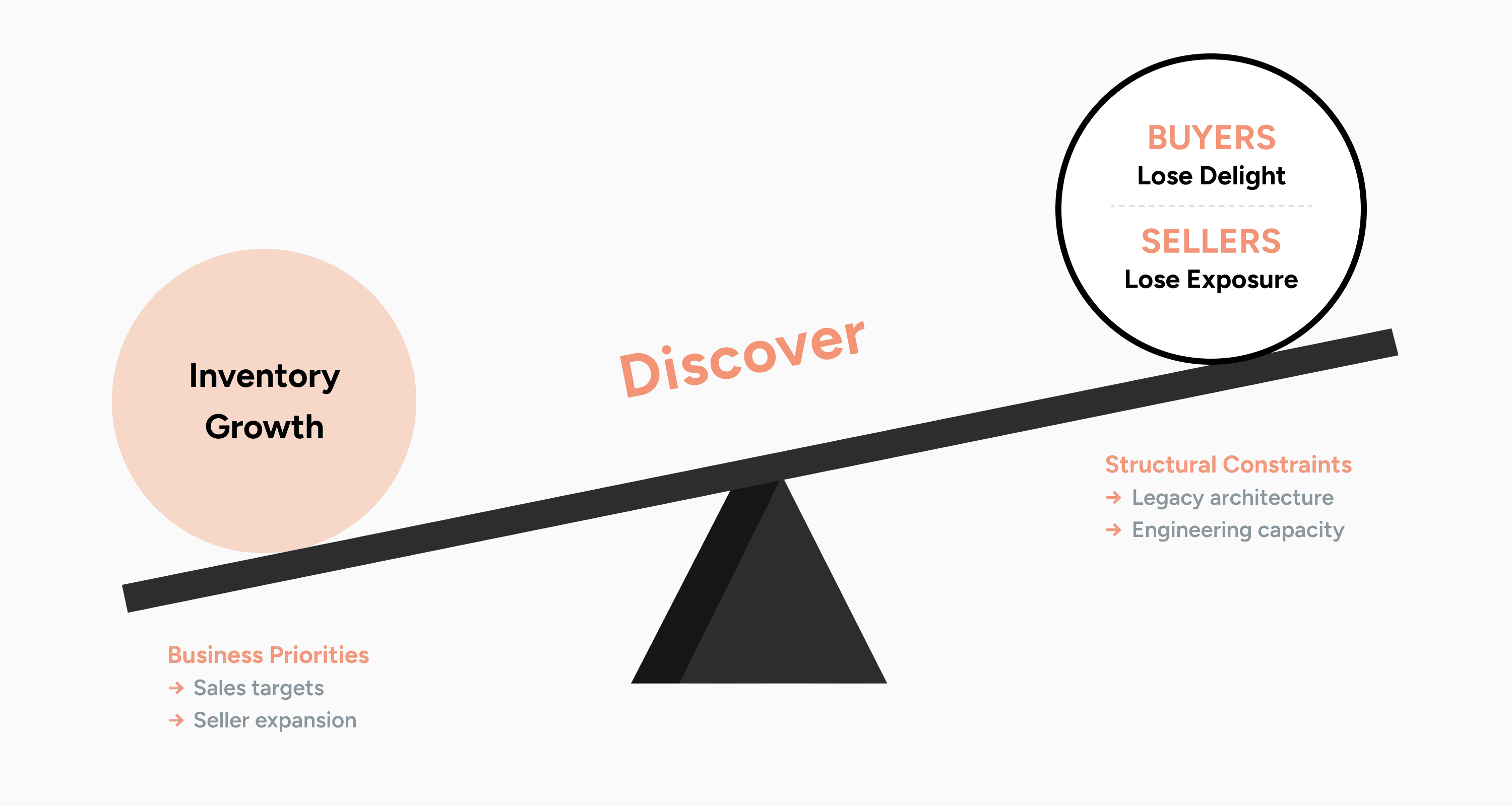
Discovery sat between opposing forces: business growth pushing for more inventory, user experience demanding clarity, and structural constraints limiting what we could surface.
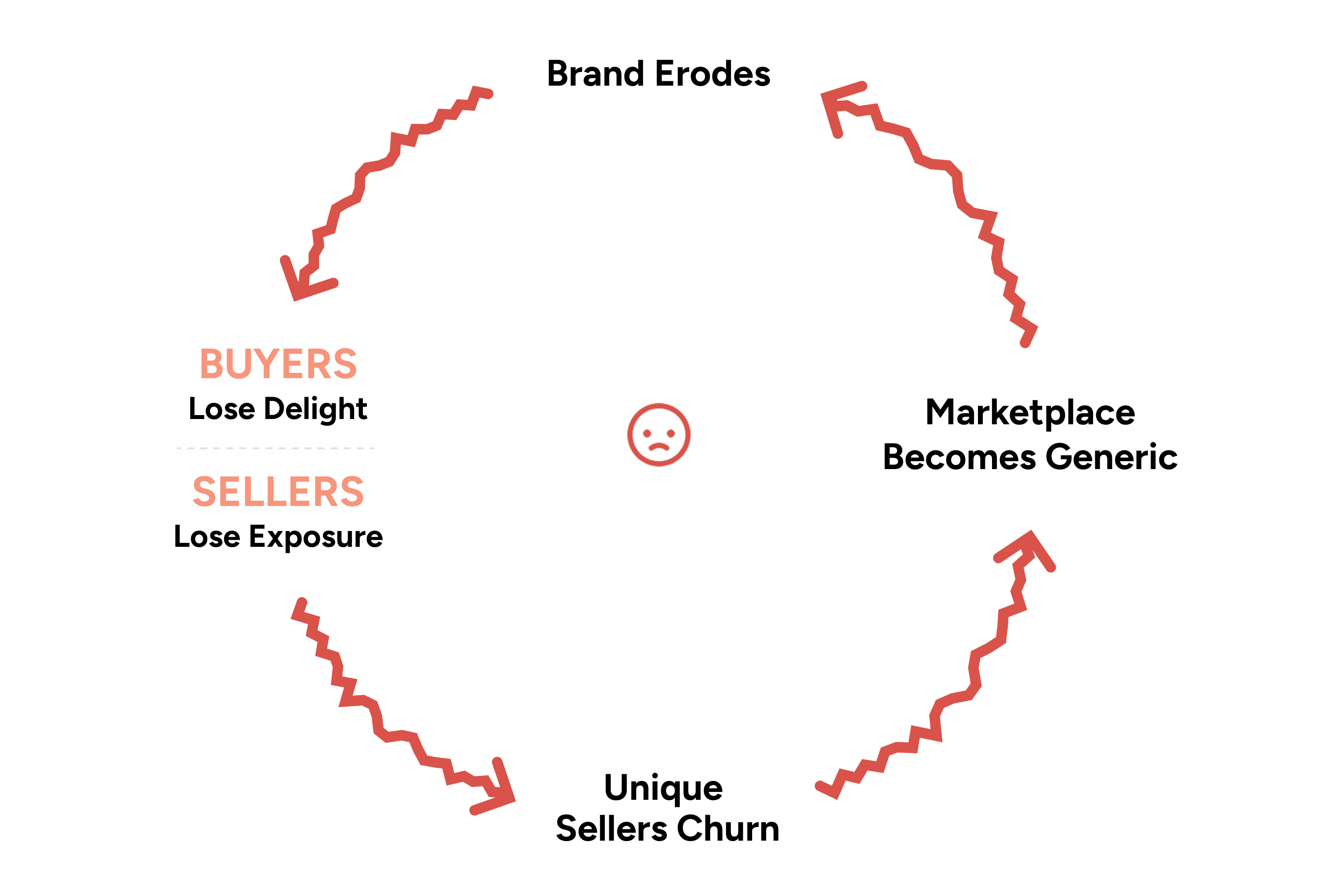
As inventory expanded under structural constraints, the discovery experience tilted, making it harder for buyers to find delight and for sellers to gain exposure.
Surgical strategy over full redesign
Rather than rebuild everything, I chose a precise approach that could compound while managing risk. With one buyer squad, I identified changes that could build on each other.
Over 12 months, I led multiple targeted initiatives that addressed different facets of the discovery problem, bringing in brief support from a second squad for one project. This approach let us test, learn, and iterate without disrupting the user experience or straining development capacity.
First Signs
"Nothing catches my eye" had become one of the most common complaints. The question was: where exactly was discovery breaking down?
What the feedback revealed
To understand why users were leaving, I dug into months of pop-up survey responses, focusing on open-ended questions about browsing challenges and user workarounds. Three primary issues emerged:
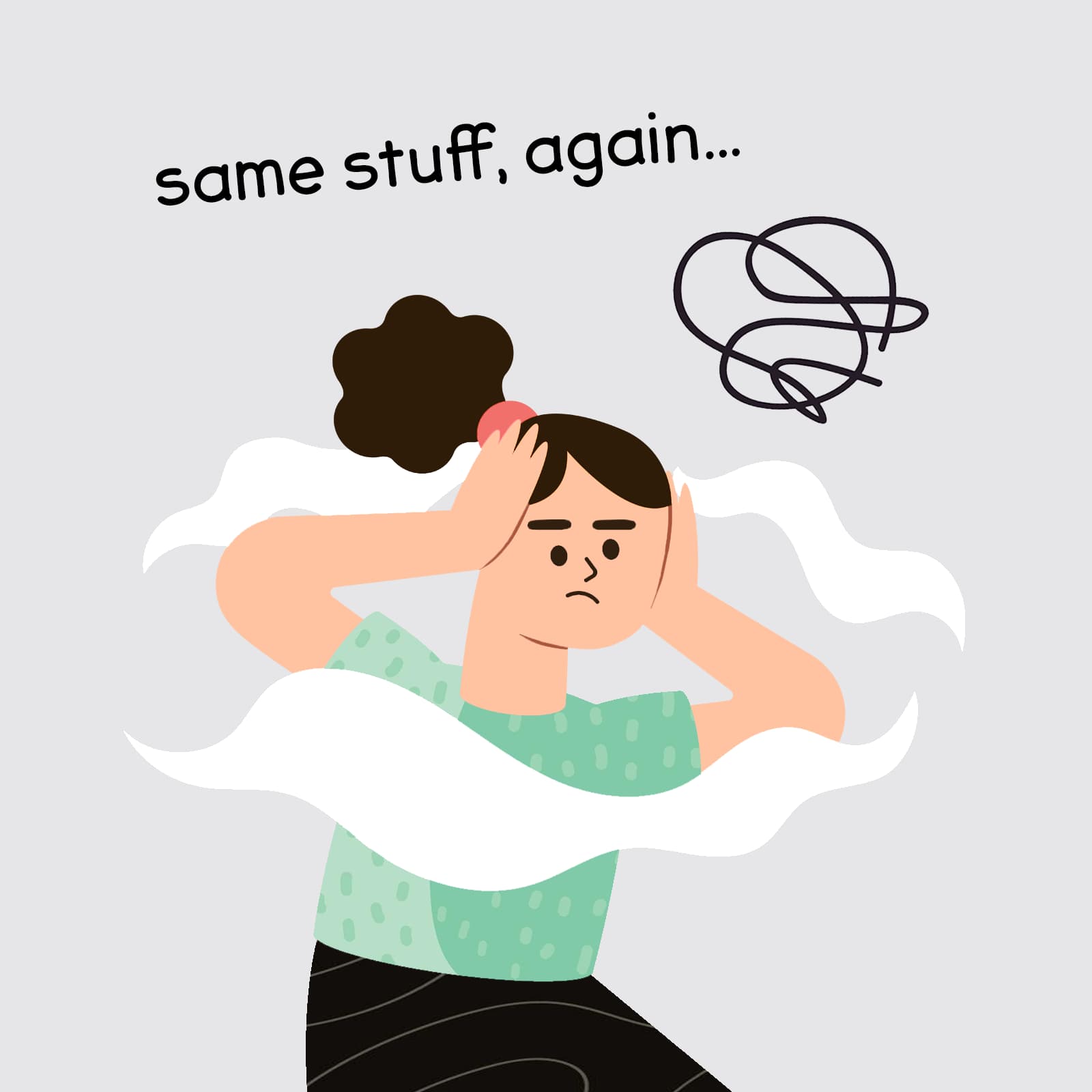
Repetitive content overload
Users kept seeing the same products and brands across sessions, making discovery feel stale.
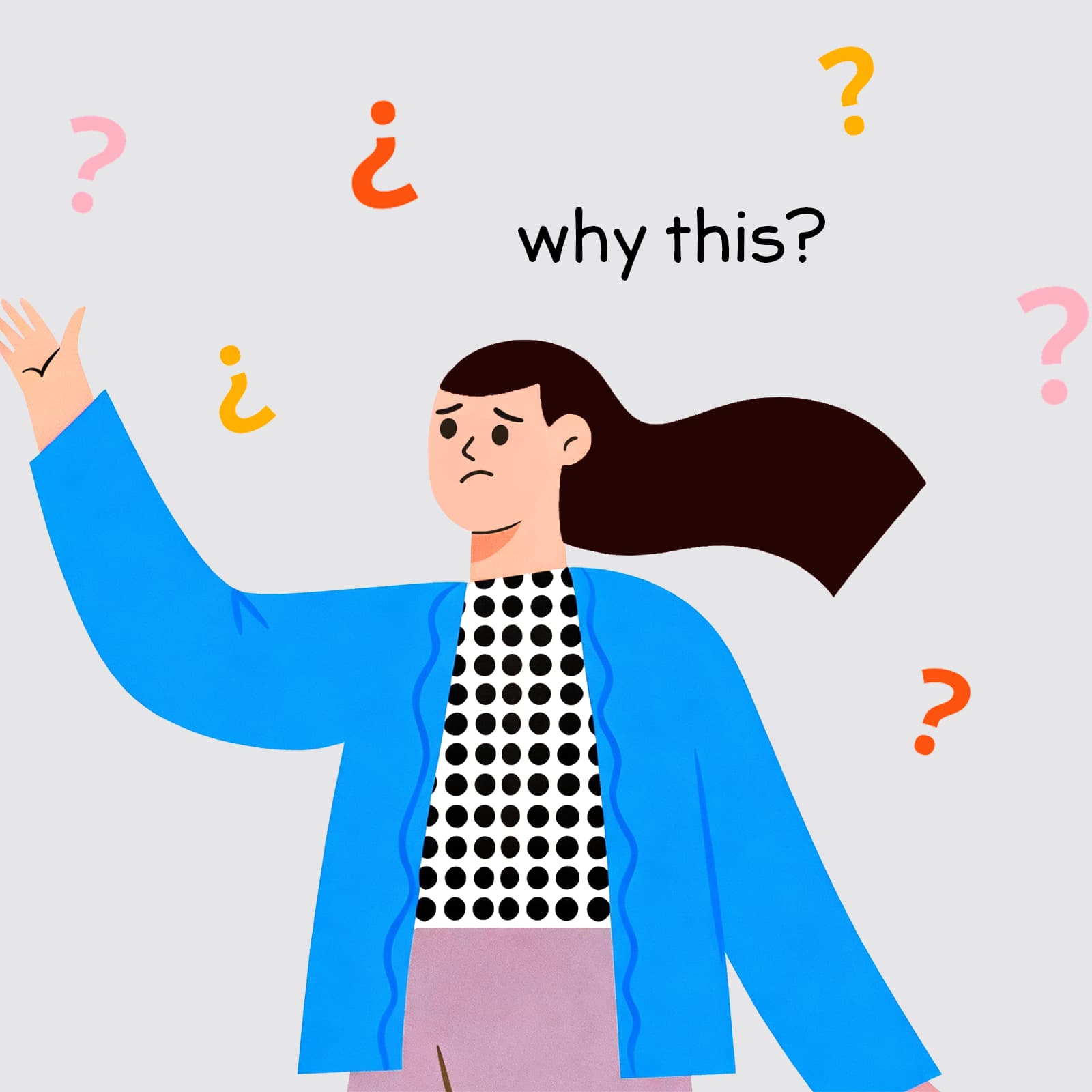
Lack of personal relevance
Recommendations felt disconnected from their interests, making them question the platform's understanding.
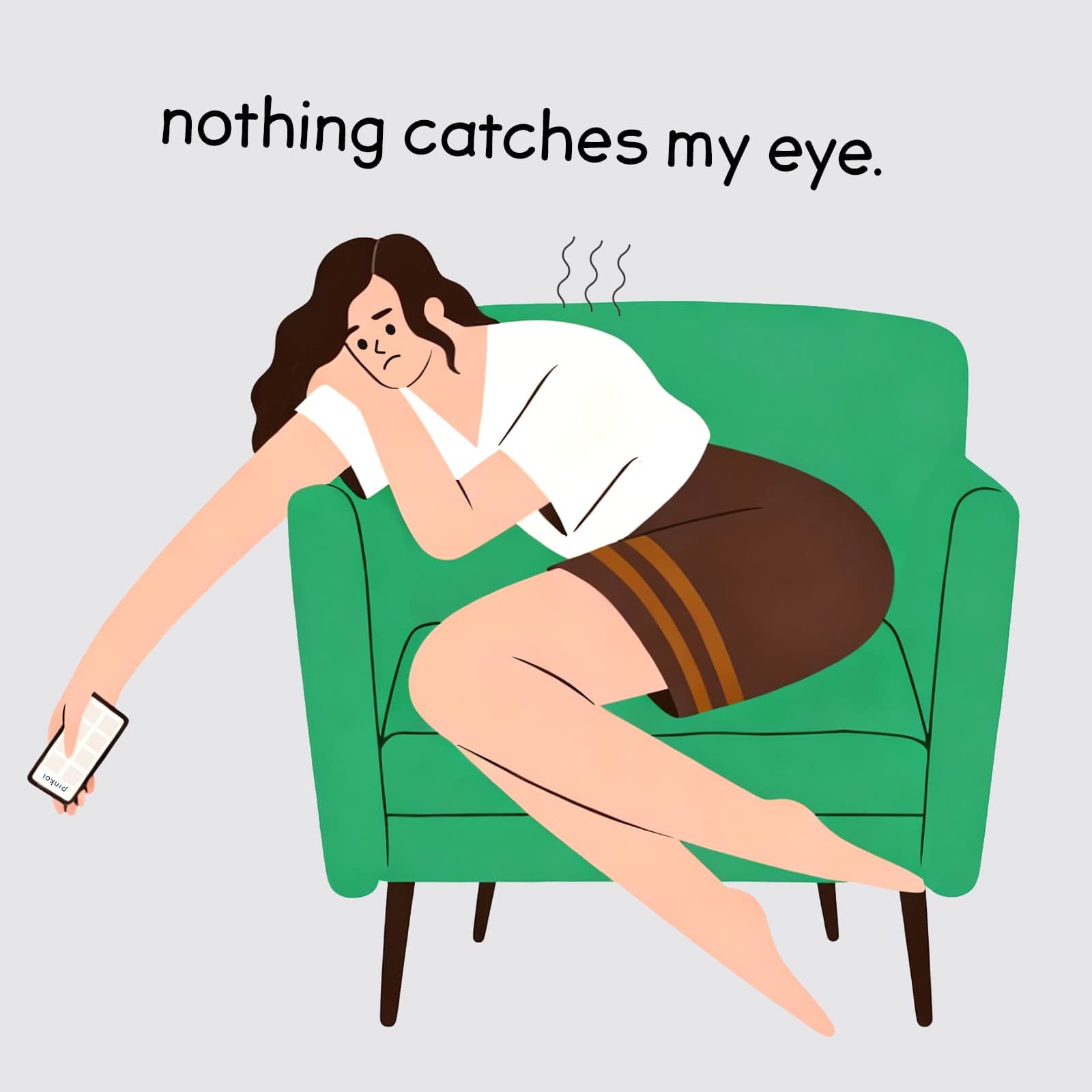
Insufficient inspiration trigger
Users reported that browsing no longer sparked the curiosity and delight Pinkoi was known for.
The Discovery
Unique isn't unique anymore
The discovery pain points revealed a deeper problem: brand erosion.
The expectation–experience gap
Pinkoi had always “owned” unique. The ability to find customizable items, international designs, and surprising gifts was our strongest differentiator.
But a gap had opened between what users expected and what they experienced:
Users expected: "I come here for inspiration and unique gifts."
Users encountered: repetition, irrelevance, and lack of inspiration
Pinkoi’s brand value was built on differentiation, and that difference was fading.
The brand promise crisis
We conducted research on how longtime members' perceptions had shifted:
Members still expected Pinkoi to be their go-to source for niche brands, customizable products, and novel finds. Yet over 50% of our inventory now felt available elsewhere. Users increasingly saw Pinkoi as just another e-commerce platform.
When asked which words no longer fit, 26% of members chose "unique," central to Pinkoi's brand identity.
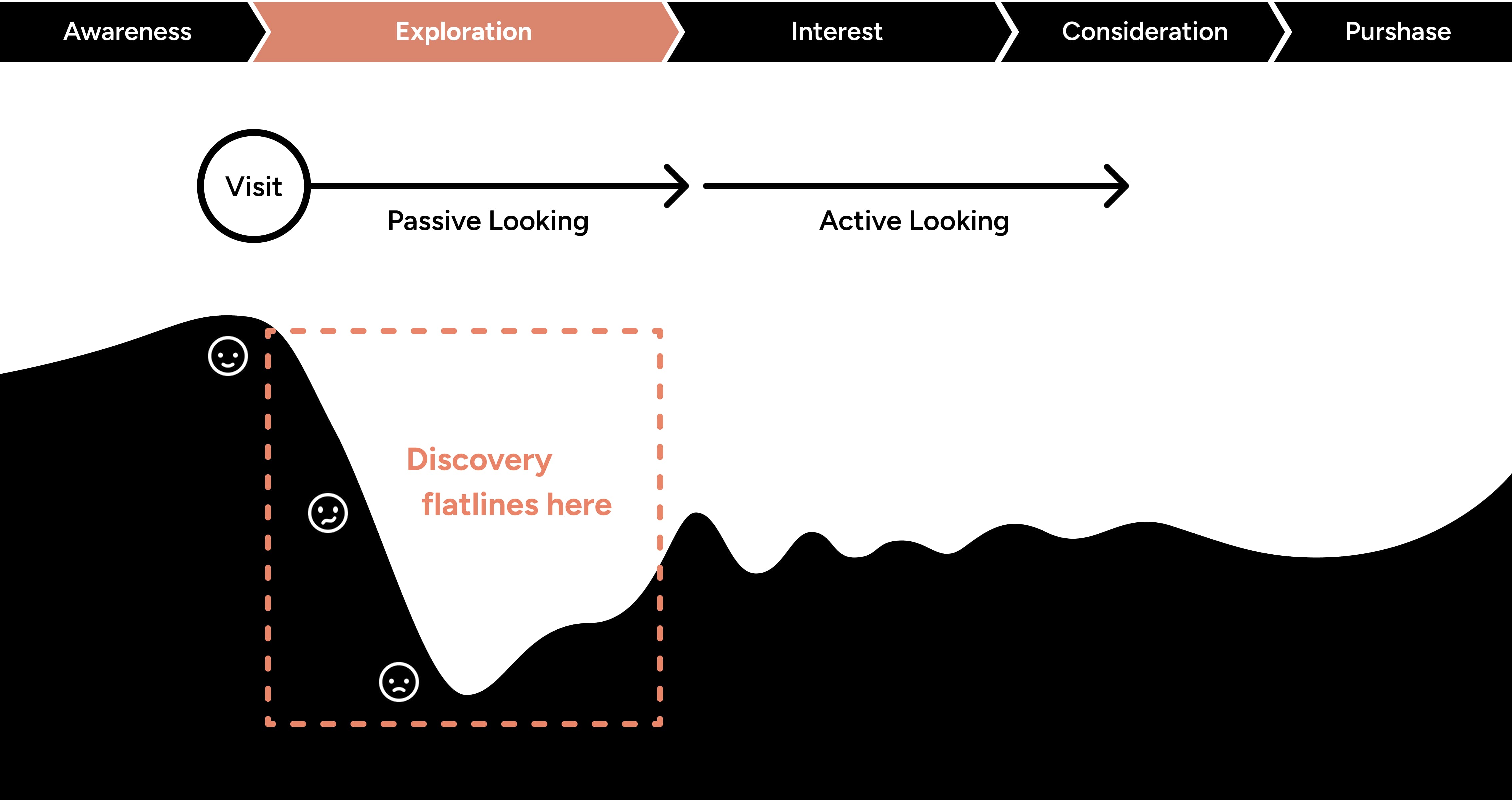
Brand erosion was breaking the buyer journey at its start.
Deeper Insights
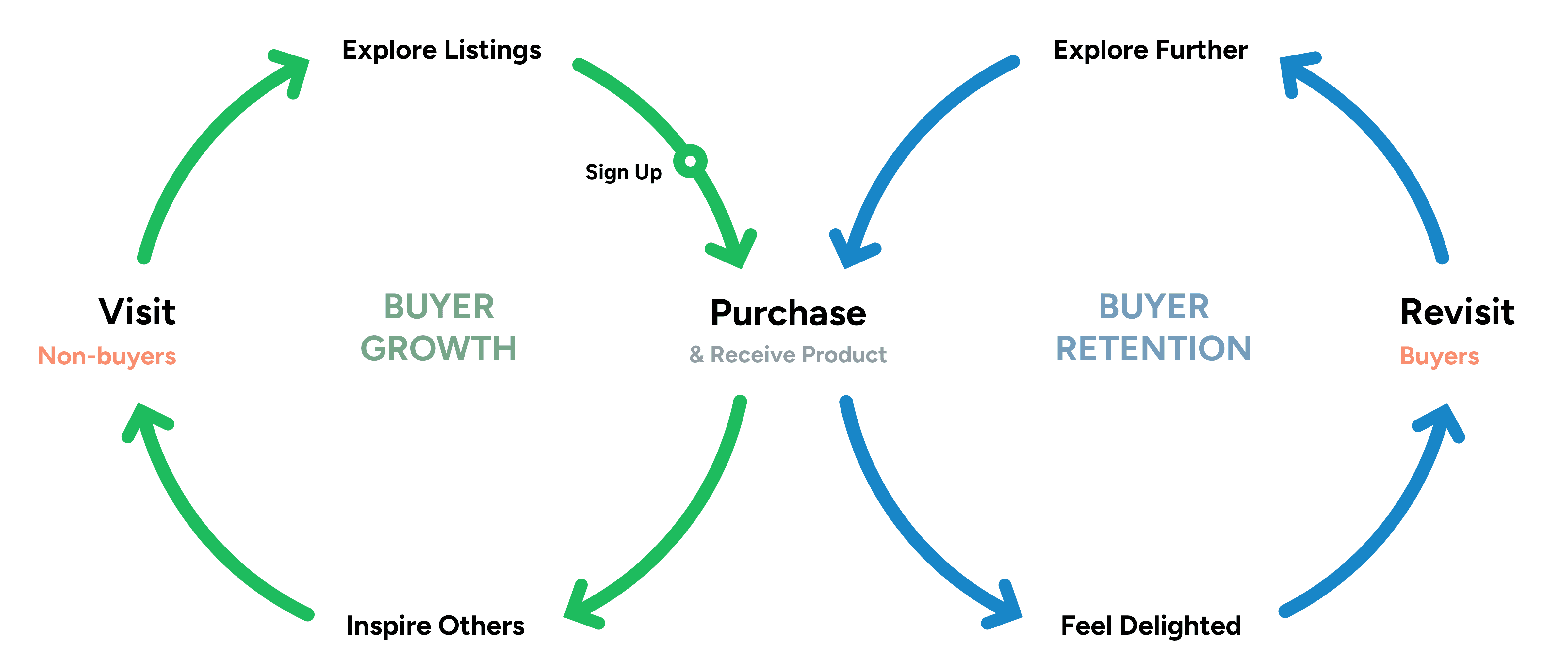
Previously, I had visualized the customer lifecycle as two critical loops, growth and retention, to show the team the core forces driving each. The brand erosion wasn't just perception; the data showed our discovery system was breaking down.
The growth and retention loops were both failing, not from lack of traffic, but because discovery had stopped creating delight. When users stopped finding inspiration, they stopped sharing Pinkoi.
The data showed exactly where the breakdown happened.
Discovery breakdown across all users
49% of direct visitors left without clicking a single item. Those who stayed averaged just 1.5 item views per session. Despite millions of users actively seeking us out through referrals and organic search, almost no one was discovering anything.
The same pattern held even among our highest-intent users. Discovery was failing nearly everyone, regardless of how long they stayed.
The retention freefall
The retention data was more concerning. Core buyers were declining while sleeping buyers surged across all major markets. Our most engaged customers drifted away, and we were struggling to reactivate those who had already disengaged.
The data confirmed what our research had suggested: even buyers who'd previously found value in Pinkoi were losing the habit of returning. After years of building loyalty, we were watching it evaporate.
Homepage: losing prime real estate
Homepage metrics told a clear story. Only 20–30% of visitors scrolled beyond the fold, and click-through rates sat at just 1% even in prime real estate areas like hero banners and featured topics.
The homepage had become a battleground, cluttered with content that confused users and diluted Pinkoi's marketplace identity.
The real retention driver
The biggest insight came from analyzing what actually brought users back. Retention was not powered by discounts, promotions, or even product variety. It came from freshness, the expectation of novelty and surprise.
People returned when they trusted they would discover something new. This explained why brand erosion was so damaging: we had lost our 'unique' positioning and the sense of discovery that made Pinkoi special.
When people could no longer count on that spark of surprise, they stopped opening the app altogether.
Reframing the Problem
Single pathway traps different user types
Finding what was broken wasn't enough. I needed to understand why it stayed broken, which meant looking at internal dynamics, not just user behavior.
The hidden bottleneck
Stakeholder interviews showed why this persisted. Teams treated the first fold as the only reliable path to exposure, creating a zero-sum battle for slots.
Even with data showing banners had limited impact, the belief in homepage dominance kept driving short-term decisions across teams. Features that should have worked together competed instead, fragmenting the experience and confusing users.
The app compounded the problem. Visitors hit a wall before they could even start exploring. Only 1 of 5 tabs was accessible without authentication, trapping teams in competition for limited space and leaving users with few entry points.
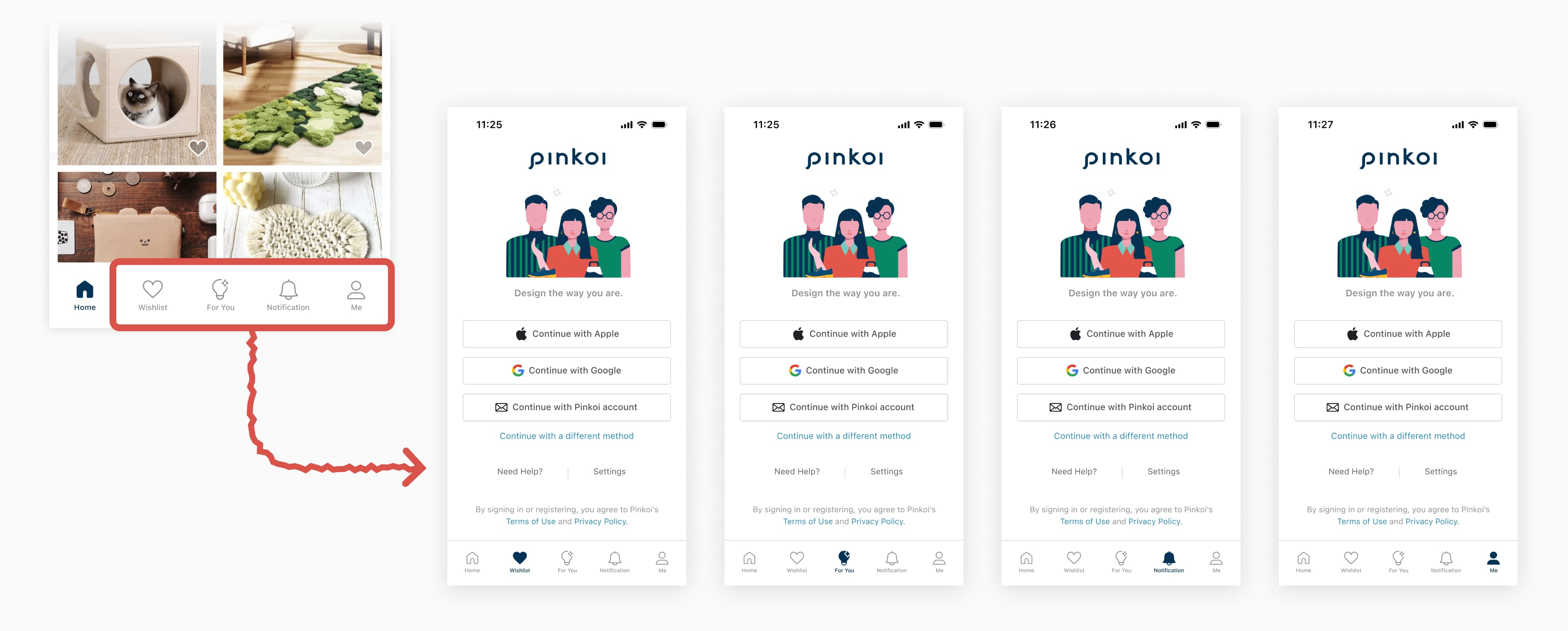
The conversion data showed users who explored using multiple functions showed 2.8× higher conversion rates, yet only 17% of users did so. For most users, effective exploration was hard to achieve.
We couldn't just optimize within existing constraints. While mediating between teams might have eased some tension, the real solution was expanding the opportunity space itself.
The question shifted from “How do we fix discovery?” to “How might we give every user a path into rediscovering what made Pinkoi special?”
I restructured the opportunity space to enable multiple discovery paths, giving teams room to contribute and users ways to explore that matched their intent.
This became Inspiration Compass.
Solution
Inspiration Compass
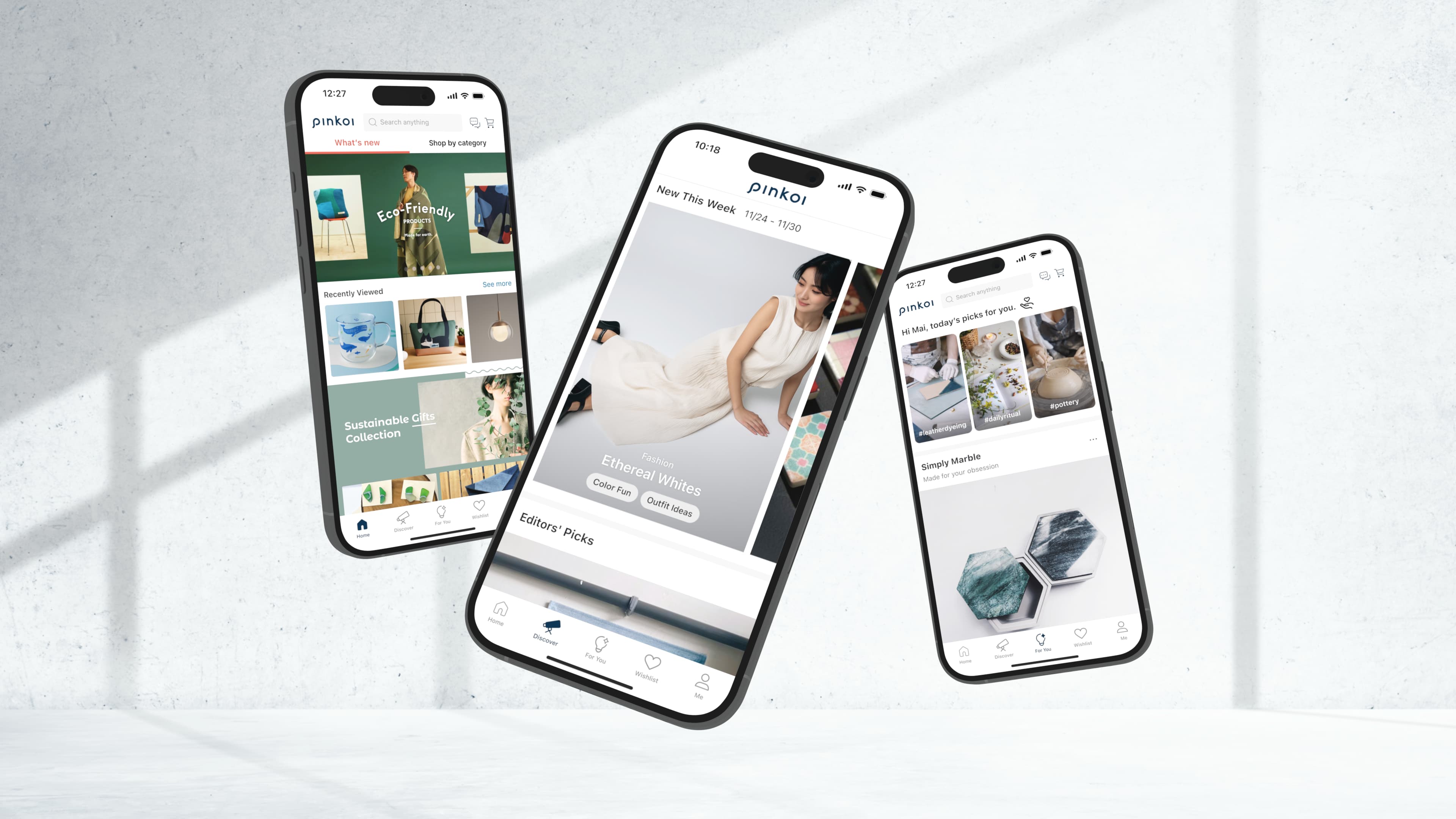
Inspiration Compass replaced single-entry discovery with a multi-path architecture, shifting from passive product display toward content-led commerce.
Expanding the opportunity space
We opened discovery from one accessible tab to three purposeful pathways.
Home became the welcoming front door, combining themed storytelling with a streamlined Categories hub for direct browsing.
This allowed teams to tell cohesive brand stories, while offering users clear places to begin. A “Japanese Minimalism” story could connect ceramics and textiles into one narrative, creating cohesive campaigns and clearer discovery themes.
Discover was the inspiration hub: a magazine-style editorial space where curated stories met contextual shopping. Here, users could explore design philosophies, lifestyle inspiration, and the stories behind unique products.
Feed deepened personalization for returning users with recommendations shaped by their browsing patterns.
Each tab connected with the others, creating pathways rather than dead ends.
From product grids to contextual storytelling
We focused on what users experienced inside these pathways, replacing endless product grids with content that activated purchase intent.
Discover was the centerpiece: editorial stories presented lifestyle scenes instead of isolated products, helping users envision how products fit into their lives.
Like 'a cozy haven for cat lovers,' for instance.
This editorial approach led to Shop the Look, letting users interact with tagged products as complete aesthetics.
A product tile shows an item. An editorial story shows a life it fits into.
Building adaptive intelligence
The third piece focused on infrastructure that could learn and scale while preserving Pinkoi's curated identity: a style taxonomy to capture cultural nuance and enable personalization across aesthetics.
Our hybrid curation workflows split the work: AI clustered products and suggested groupings. Curators refined the terminology and validated choices. User behavior closed the loop.
Guest experiences in Feed let visitors sample what personalized recommendations would feel like, reducing friction and building early trust.
Style-based discovery was phase one. We built the infrastructure to expand: style first, then occasion, then mood-based discovery.
Bringing it all together
Every user, their own path
Goal-driven shoppers used search. Window browsers explored categories or editorial stories. Inspiration seekers started with Discover. Returning users got personalized feeds. Each found their natural entry point.
Stories that activate desire
Editorial content reframed products as lifestyle moments. Instead of showing a ceramic mug in isolation, we presented "morning rituals that center your day," helping users see how it fit into their lives.
Curation that learns
The system blended algorithmic scale with curatorial judgment. AI clustered products by style, curators refined the vocabulary, and user behavior validated what worked. Personalization felt both smart and tasteful.
Results
Measurable impact across the system
Ecosystem impact
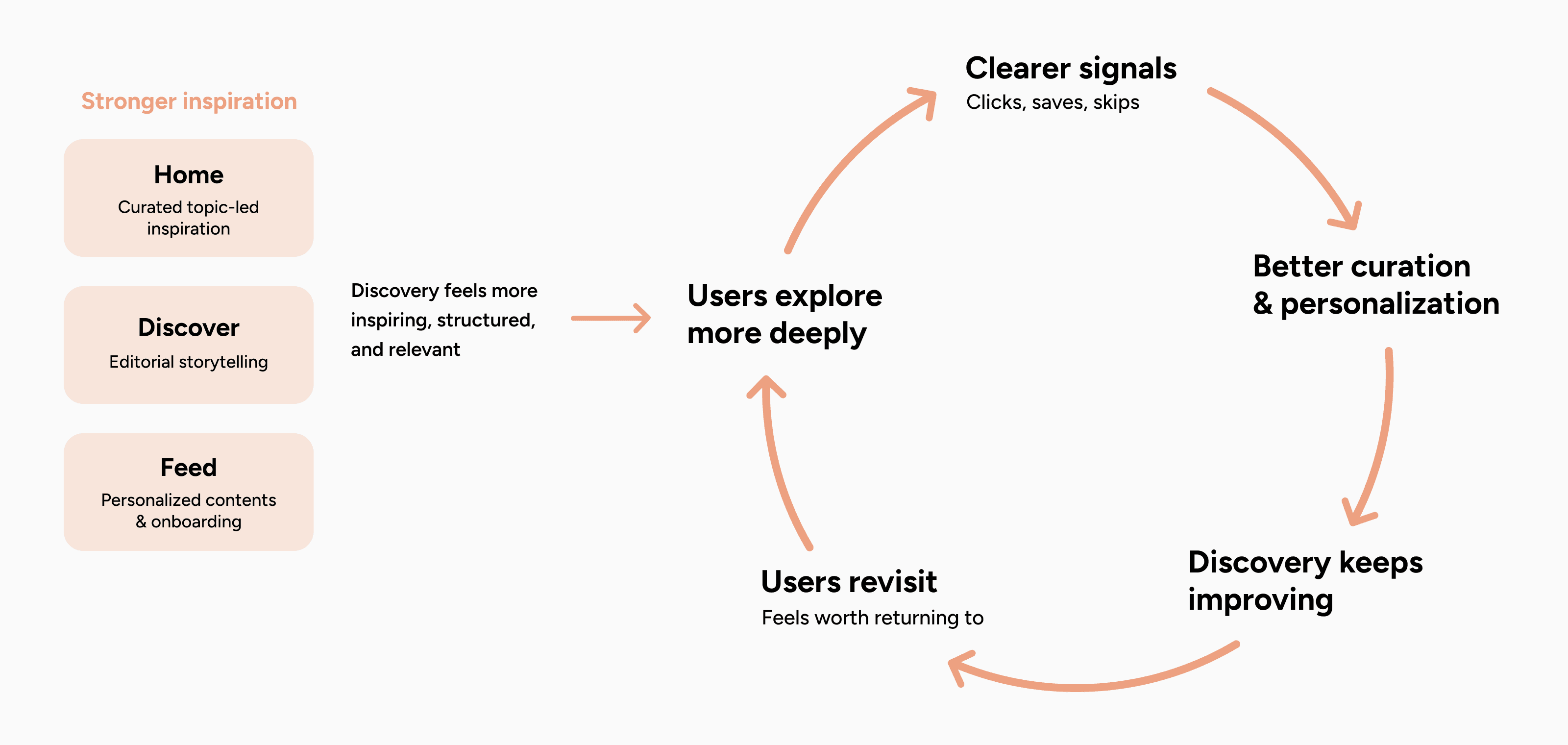
Adoption varied at first, but over three months, the components began reinforcing each other:
Homepage: Cohesive, theme-based storytelling through topic cards drove a 9.5× increase in click-throughs.
Discover: Once friction was reduced, users browsed an average of 12 items per session, an 8× increase that showed editorial curation sparked meaningful exploration.
Feed: Gamified onboarding lifted engagement by over 300% and doubled preference completion, giving the personalization system better data to work with.
The surfaces reinforced one another. Users who explored Discover returned more frequently, with revisit rates climbing from 15% to 43%.
This created a sustainable loop: users entered through inspiration, explored more deeply, and returned with clearer preferences, strengthening both engagement and personalization.
Optimization insights
Discover launched with strong early adoption, but only 2% of users clicked into the editorial stories. When they did, engagement was strong: 34-37% clicked through to product pages and browsed an average of 12 items per session.
The problem was discoverability. We ran quick tests including localized story titles, reduced image height, tag hints, and weekly notifications. Within weeks, product page visits from Discover rose 10%, and adoption increased from 19% to 26%.
User validation
Users told us directly what the metrics showed:
"I keep coming back to the Discover tab. There's always something I didn't expect to love."
“Love the update! I finally feel excited to open the app again, it’s refreshing.”
"After completing the onboarding tasks, my feed felt spot-on, like it really gets me."
"It's nice to see more small brands again. It feels more like the Pinkoi I remember."
Users were rediscovering why they loved Pinkoi.
External validation
Apple featured Pinkoi as App of the Day across Taiwan, Hong Kong, Macau, and Japan, spotlighting Discover and driving an 84% lift in App Store exposure.
Brand recovery and looking forward
Users formed new habits. They returned to Discover, completed preference settings in Feed, and browsed more deeply into categories.
The infrastructure (adaptive curation, style taxonomy, content-commerce integration) would improve over time as more users explored and expressed preferences. Personalization would get sharper and discovery more relevant.
Pinkoi began restoring its position as an inspiration-led marketplace, with infrastructure built for sustained growth.

👀 Behind the Strategy
Turn discovery from dull to delightful for every shopper
I started with three core questions:
What makes discovery delightful?
How do you design for every shopper?
What contexts shape discovery?
I mapped discovery's broader context to understand how these questions connected — the user behaviors, content systems, and organizational dynamics all influencing the experience.
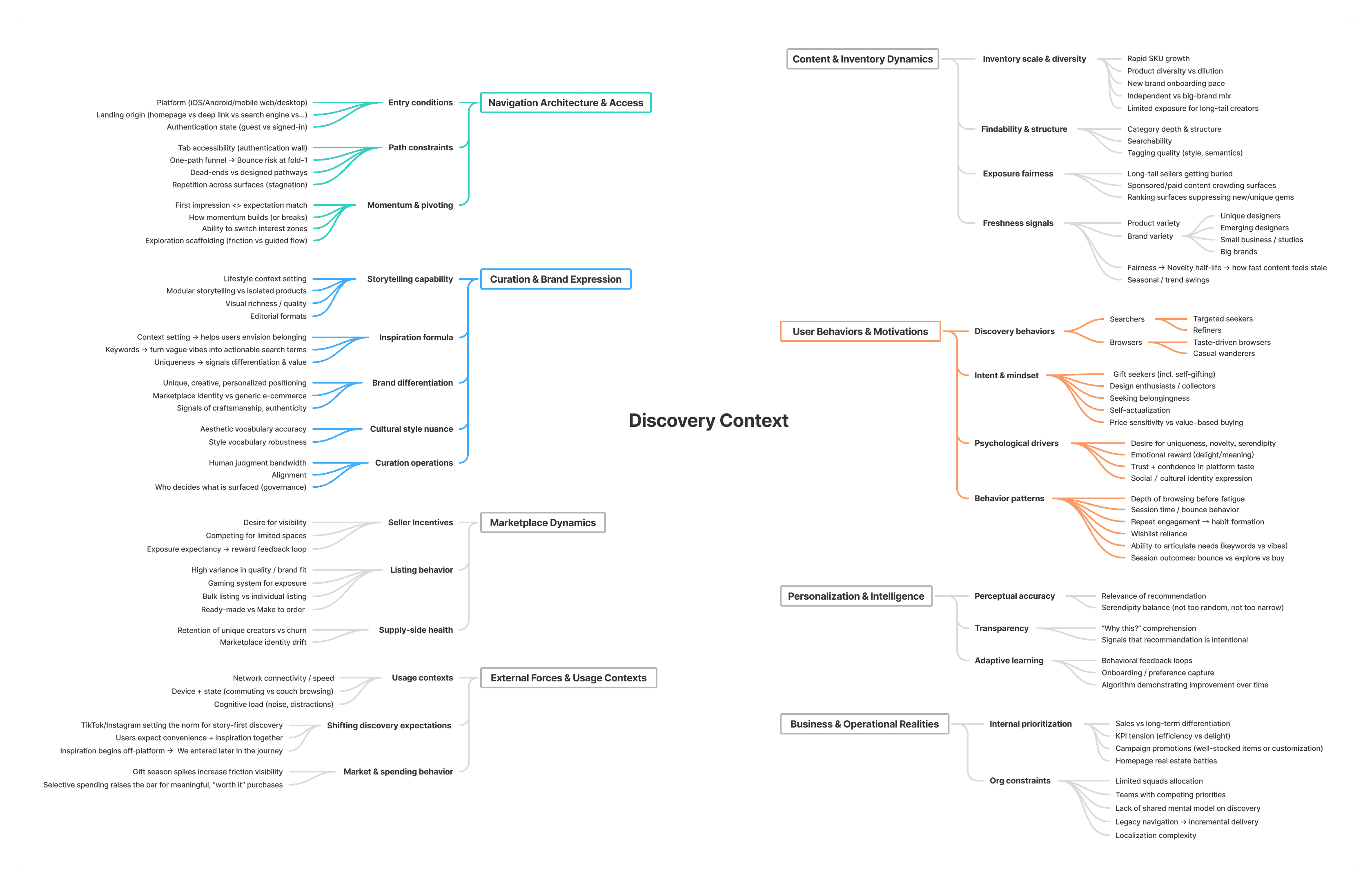
This map showed that discovery problems weren't isolated UX issues but symptoms of deeper structural tensions between what users wanted, what the business needed, and what the product could support.
Turning discovery gaps into design questions
I translated these cracks in discovery into four HMW questions that would guide my strategy:
How might we bring forward what’s truly one-of-a-kind?
How might we support shoppers’ many paths to discovery?
How might we turn browsing into "I need this!" moments?
How might we earn trust while staying curious?
These questions formed a narrative arc: Bring forward uniqueness → Support discovery paths → Activate desire → Build lasting trust.


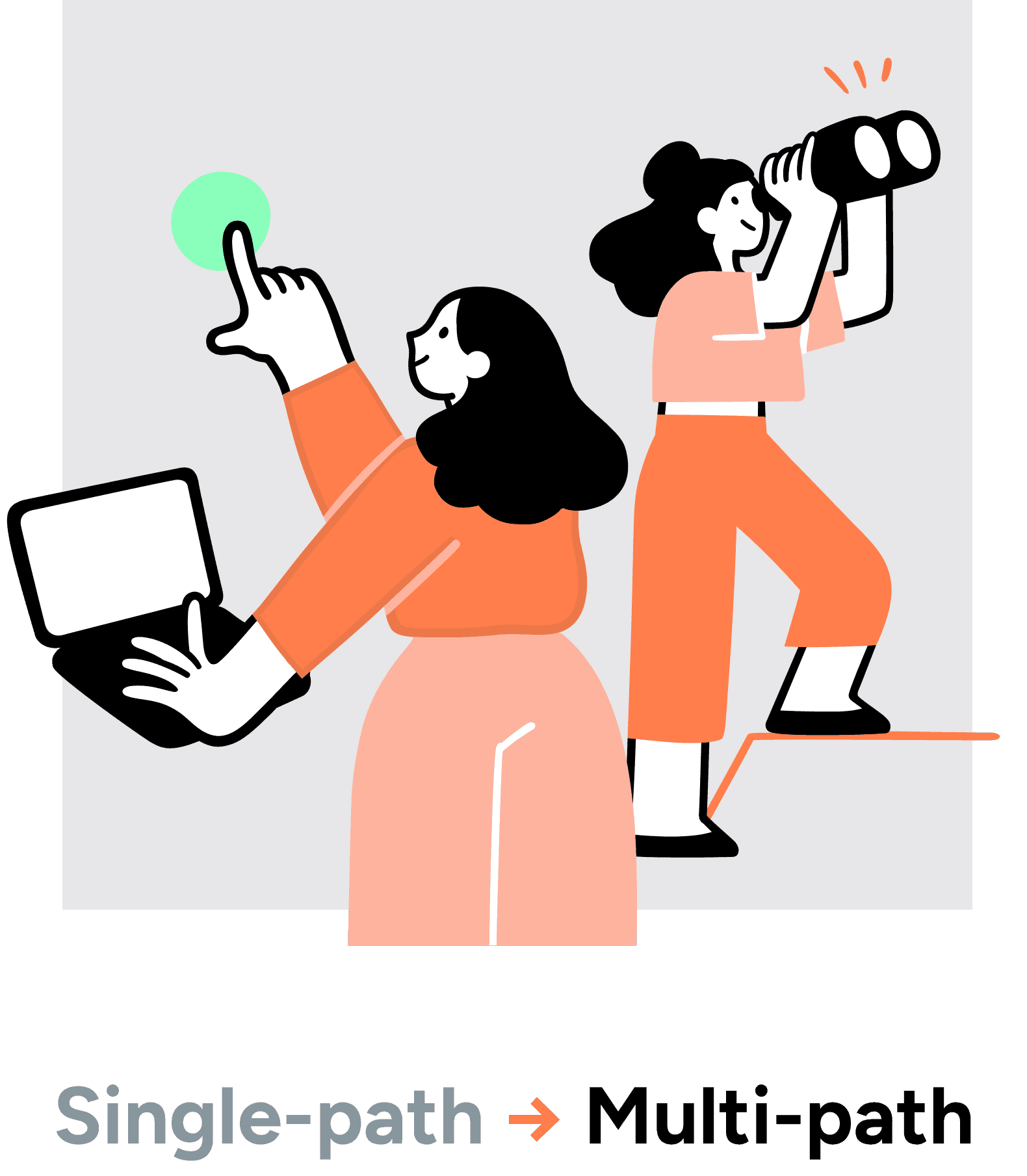
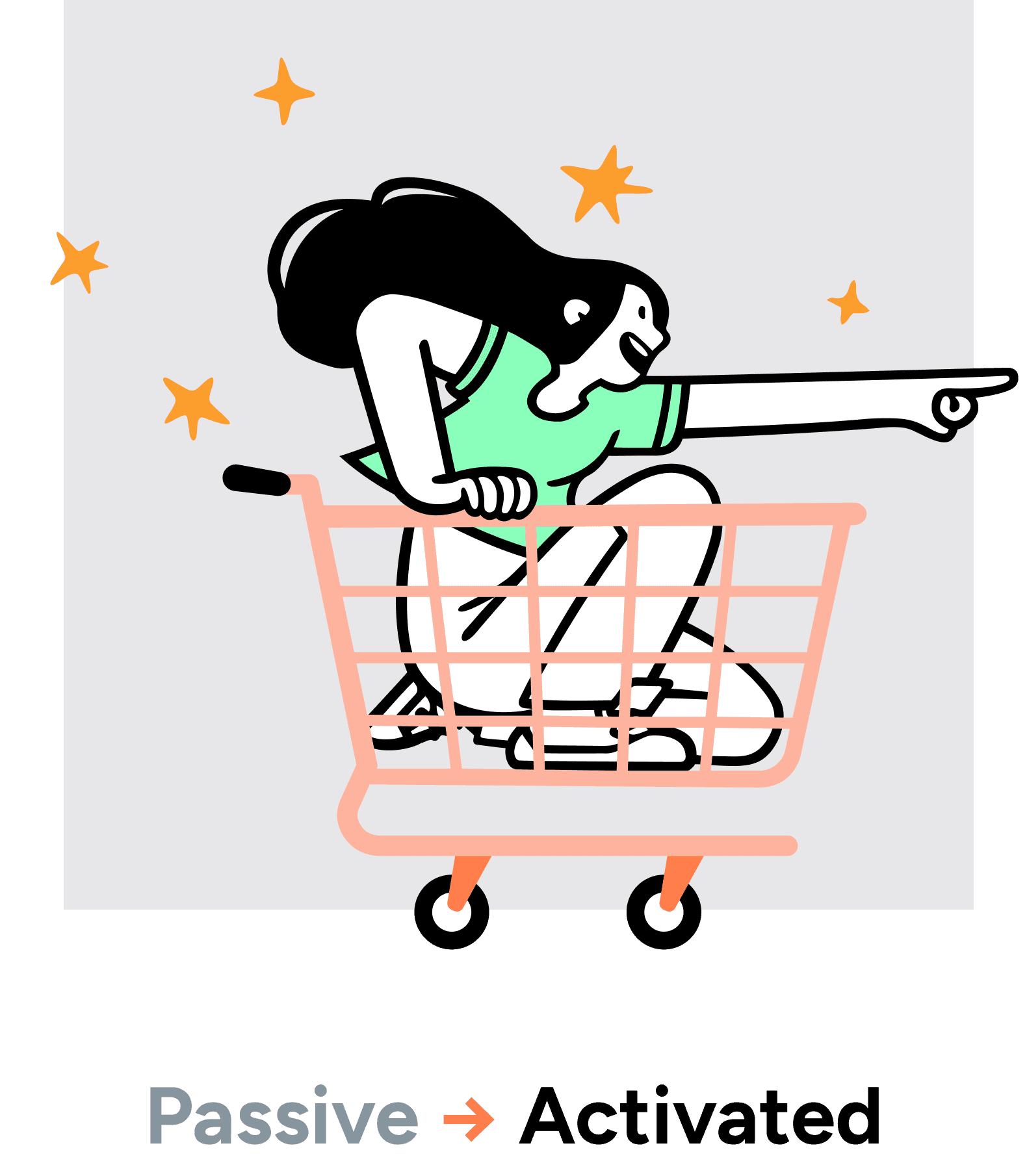

Noisy → Tailored + Single-path → Multi-path
Turning noise into tailored journeys
Navigation scarcity was strangling discovery.
Only 20–30% of homepage visitors scrolled, and with just 1% CTR in prime real estate, most users never started exploring. Authentication walls blocked access to 4 of 5 tabs, stopping 50–80% of users before they could build any momentum.
Think of it like a narrow river during a flood. When water volume exceeds capacity, it overflows. But when users hit navigation constraints, they didn't overflow into exploration — they just left.
Why one path couldn’t work
Our user research had identified two primary discovery behaviors:
Goal-oriented shoppers arrived with specific purchase intent and expected efficient ways to narrow down to the right product. Their typical journey: Search → Product → Similar Products → Shop. They avoided the homepage entirely, finding recommendations irrelevant and repetitive.
Window shoppers came to browse and be inspired, expecting Pinkoi to surface novelty and surprise. Their typical journey: Homepage → Categories ↔ Products → Similar Products. Some browsed homepage content first, while others jumped directly to categories.
Within these two groups, we observed four distinct subtypes:
Targeted seekers
Came with a precise product in mind and used search almost exclusively.
Refiners
Started with a vague idea and relied on progressively narrowing results.
Taste-driven browsers
Revisited favorite categories, styles, or brands, collecting inspiration for later.
Casual wanderers
Browsed widely with low intent, and shifted themes easily while seeking surprise.
Our single-entry architecture couldn't serve these four different behaviors. Discovery needed to adapt to how people actually explored.
Creating opportunity, not managing scarcity
Discovery broke because the architecture made content feel noisy, repetitive, and irrelevant.
My solution centered on a 2+2 navigation structure:
2 tabs always open to visitors (Home & Discover), showcasing Pinkoi's uniqueness and value upfront, even before login.
2 tabs powered by user data (Feed & Wishlist) with guest experiences (recommendations, onboarding) so visitors weren't faced with a blank wall.
Me tab remained account-only for profile and utility functions.
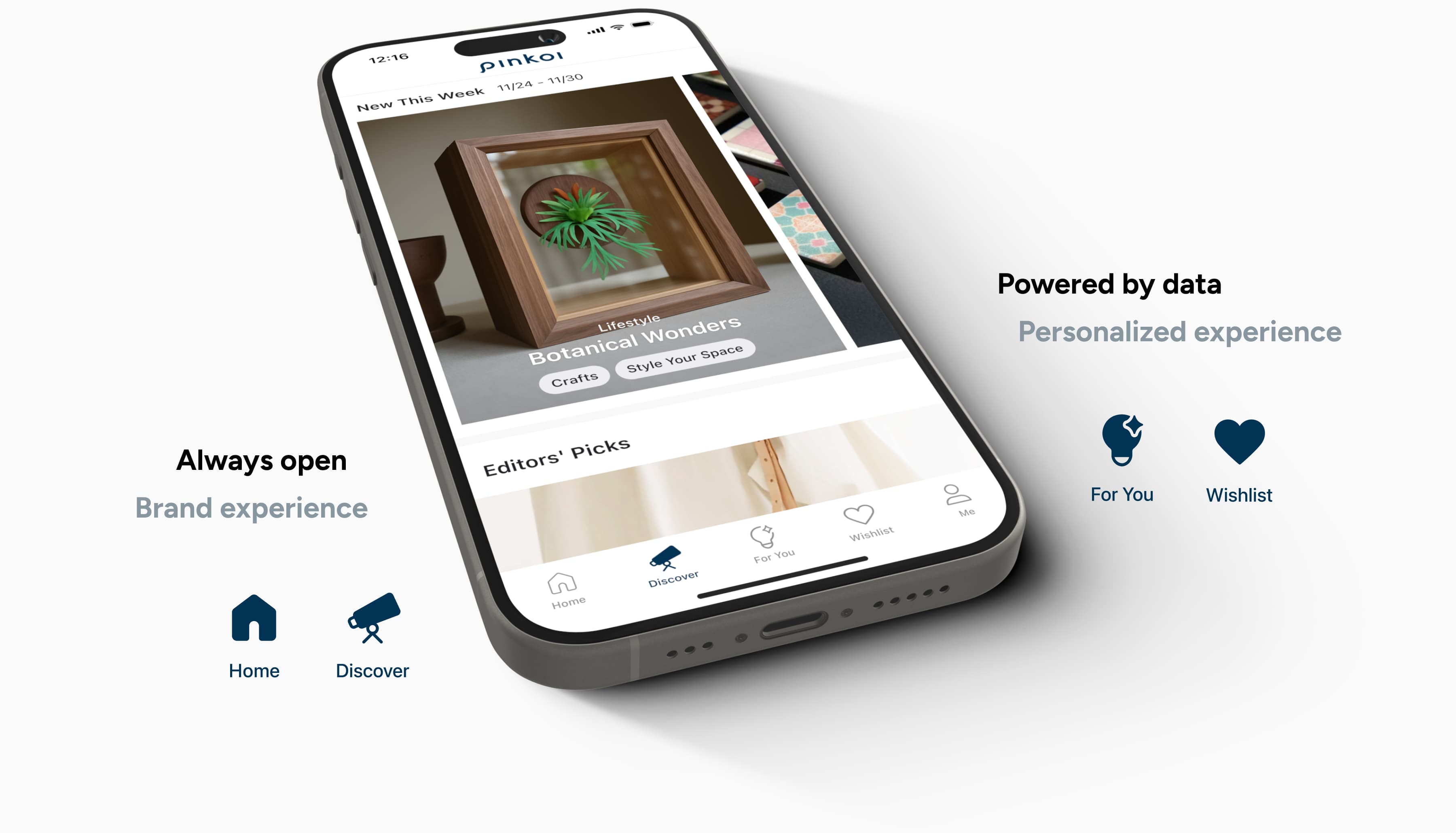
While Wishlist was part of the long-term 2+2 vision, we first expanded visitors' access from just 1 entry point to 3 tabs: Home, Discover, and Feed.
This framework created opportunity instead of managing scarcity: purposeful spaces for teams and personalized pathways for users.
The 3-tab architecture
I developed the strategy and worked side by side with our product designer and PM, joining brainstorms and reviews as we transformed navigation from 1 tab to 3.
Home Tab — Redesigned for promotional campaigns and category-driven window shoppers. Balanced business objectives with user-friendly storytelling, giving teams purposeful campaign space while preserving browsing flow.
Discover Tab — Created to showcase Pinkoi’s design marketplace identity. Magazine-style editorial stories sparked inspiration for window shoppers while giving the curation team a purposeful space to tell them.
Feed Tab — Enhanced personalization for returning users. AI-driven recommendations were paired with guest-accessible sample content that demonstrated value before sign-up, building early trust. Many continued with a lightweight preference step to fine-tune their Feed.
Home opened the door, Discover sparked inspiration, and Feed deepened engagement. Each tab worked independently but connected to guide users toward more meaningful exploration.
Bringing uniqueness back to the surface
Underneath the homepage battle was a fight over identity.
Random product grids made Pinkoi feel like any other e-commerce site, burying the unique designers and customizable items that defined us.
Our creative goal became clear: elevate design stories that showcase Pinkoi's heart.
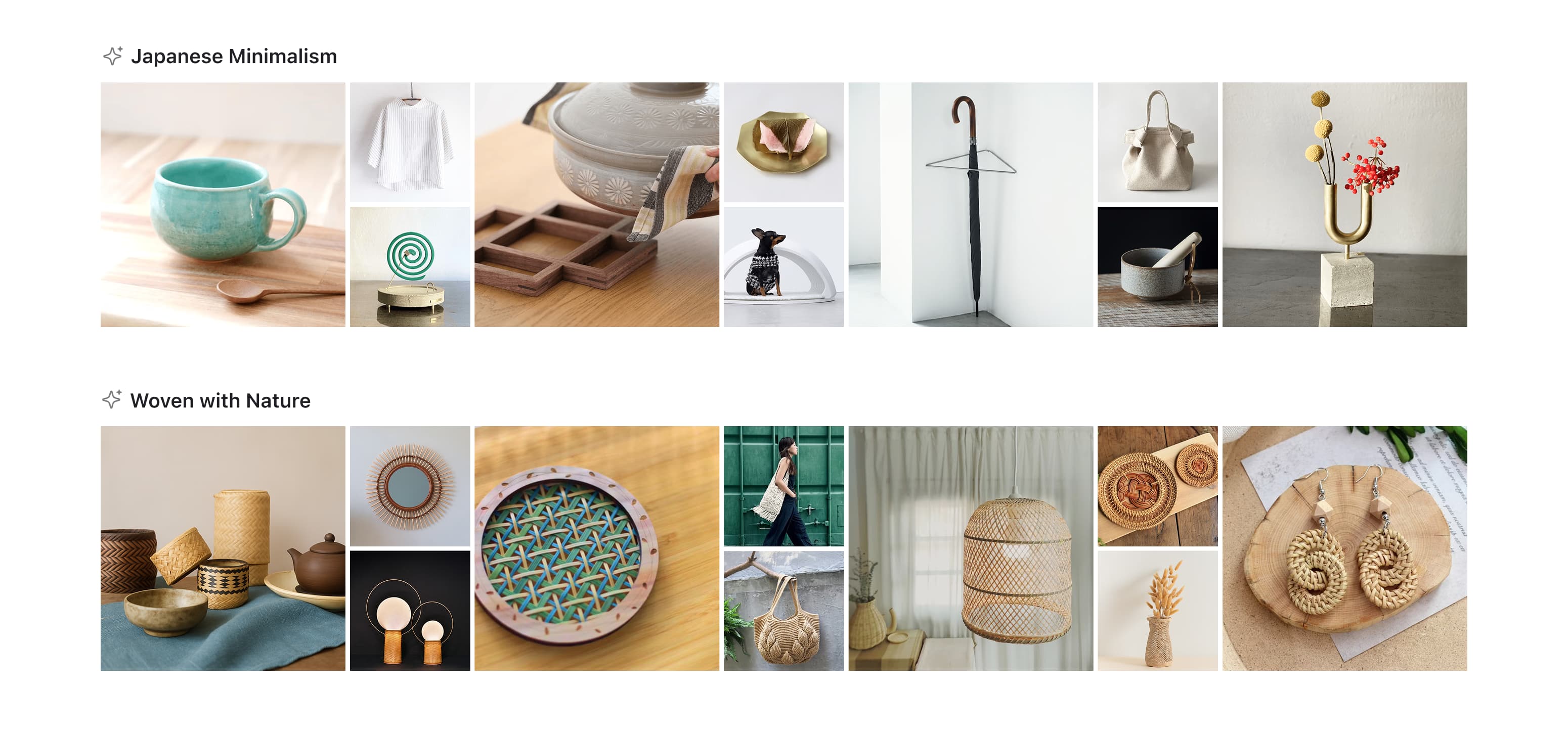
I drove the decision to create a new homepage structure and partnered with our product designer and PM on the redesign, while also aligning business teams and securing executive buy-in.
This structure brought forward what's truly one-of-a-kind and supported different discovery paths through two complementary entry points:
Campaigns landing — shifted from scattered product placements to cohesive, theme-based storytelling. For example, a 'Sustainable Living' theme could showcase bamboo kitchenware and organic textiles together rather than as isolated listings.
Categories hub — created a direct entry point for window shoppers who preferred to browse by interest, replacing endless homepage scrolling with clear category pathways.
To support this, we introduced new curation guidance for business teams, changing the question from "What products need promotion?" to "What story showcases our unique marketplace?"
The new homepage structure solved the battleground problem. Instead of blending into generic e-commerce, Pinkoi once again felt like a curated design destination.
Passive → Activated
What activates desire?
Multiple discovery pathways solved the navigation bottleneck. But users still needed content that sparked desire, not just entry points.
The harder question: what turns passive scrolling into "I need this!" moments?
We worked with researchers and data scientists to study inspiration patterns. The findings were stark: 67% of Pinkoi users showed no signs of inspiration. 51% bounced immediately, while another 16% showed minimal or unfocused engagement.
Our behavioral analysis identified five distinct inspiration states, each representing a different level of engagement and focus:
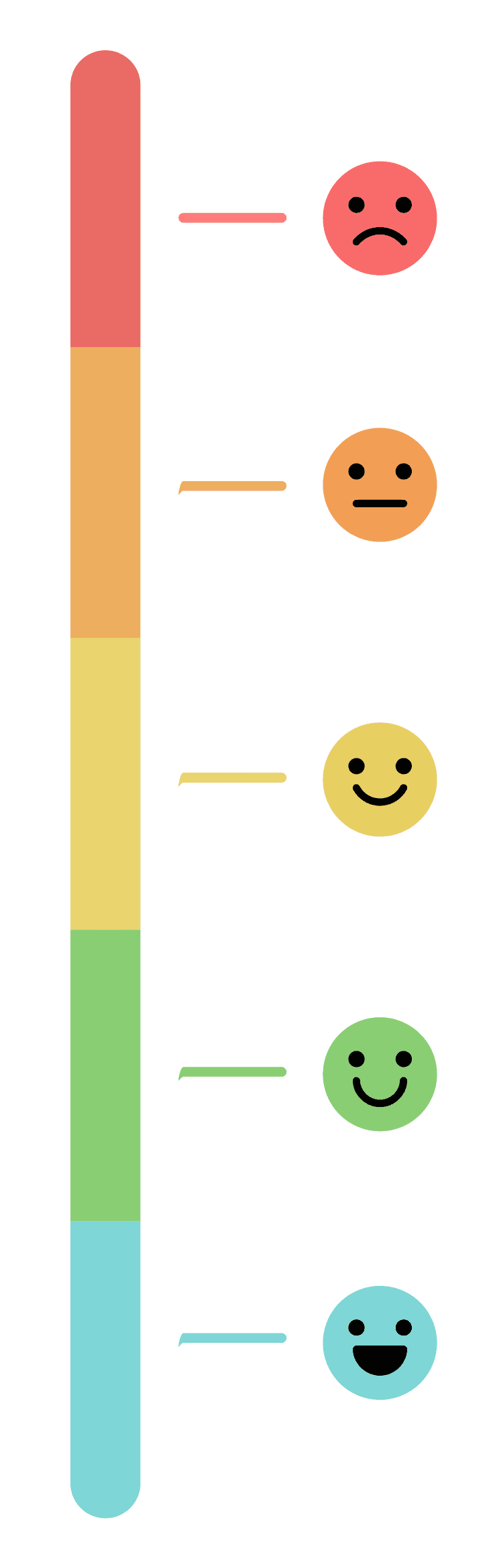
G0 — Non-Starters
Barely engaged with any products, rarely progressed beyond landing
G1 — Uninspired Users
Browsed scattered, unrelated products without focus
G2 — Inspiration Builders
Gradually narrowed to similar products, showing emerging focus as inspiration crystallizes
G3 — Inspired Shoppers
Consistently viewed related products with strong intent
G4 — Intent Continuers
Returned to saved items and similar products, closest to purchase
Inspiration states correlated directly with conversion.
When inspiration started forming (G2–G4), users started adding to wishlists and carts, with most purchases happening in G4. G0–G1 users left quickly, often within 10 pageviews, with little engagement.
The inspiration formula
We found that inspiration follows a pattern. It has three ingredients:
Inspiration = Context Setting + Keywords + Uniqueness
Each ingredient serves a distinct psychological function:
Context Setting: helps users imagine the product in their life
Keywords: crystallizes vague desires into searchable, concrete terms
Uniqueness: elevates perceived value beyond commodity alternatives
Without these, product tiles just inform, they don't create desire. For struggling users (G0–G1), Context Setting and Keywords were critical. For engaged users (G3–G4), Uniqueness drove conversion.
Why Discover could spark "I need this!" moments
The Inspiration Formula showed why editorial storytelling could activate desire when product grids couldn't.
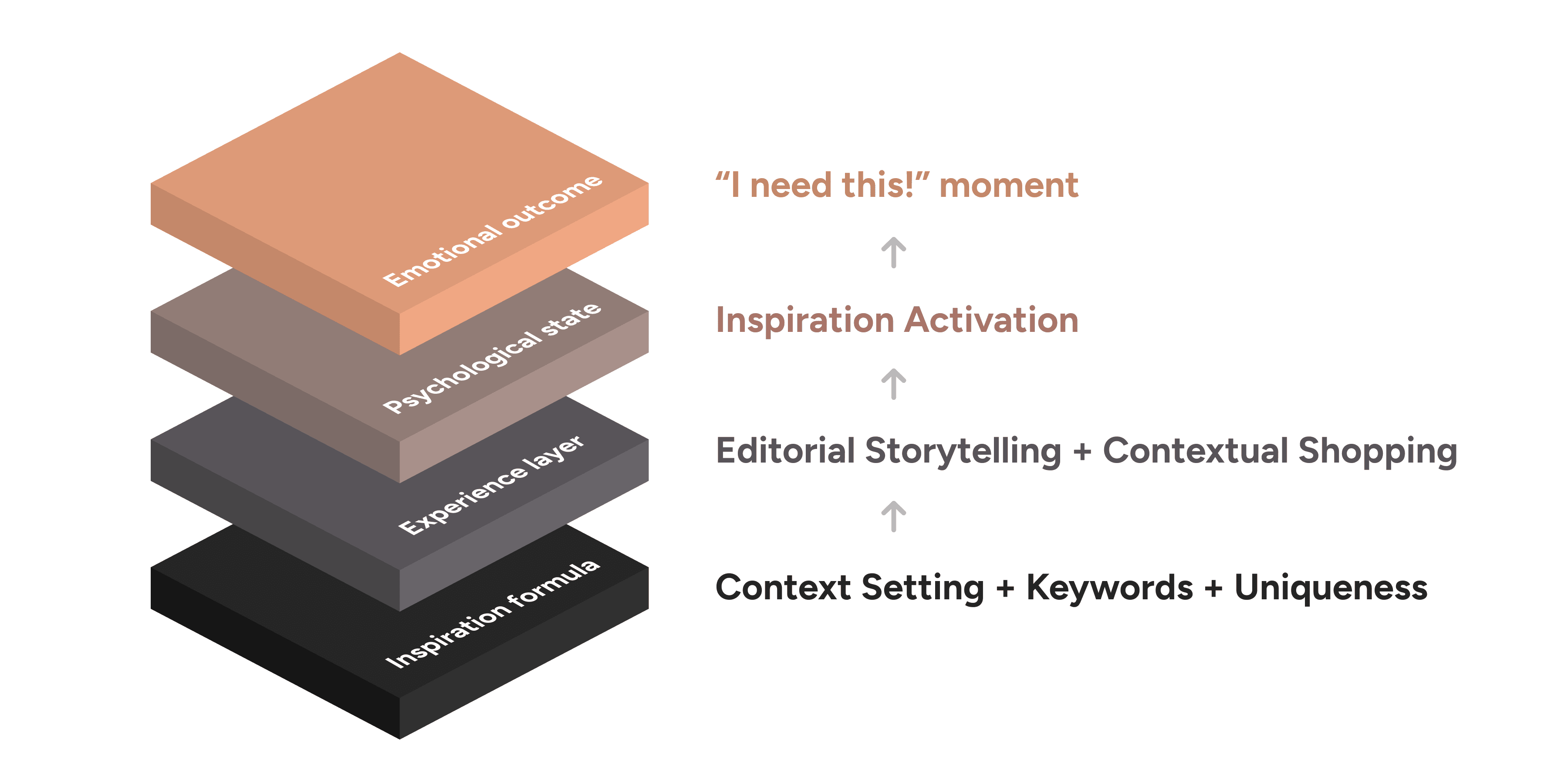
This shaped our three-tab content strategy:
Home remained the campaign front door for promotions and first-time visitors. Feed deepened personalization for returning users. Discover activated inspiration through magazine-style stories, editorial narratives, and modules like Shop the Look.
Editorial content delivered all three inspiration ingredients. We built contextual shopping into Discover, showing products within lifestyle scenes or complementary arrangements so users could imagine how they fit into their own lives:
Context Setting through Lifestyle Stories: Instead of showing isolated products, editorial content created scenarios like "evening wind-down routines," helping users visualize how products fit into their desired lifestyle.
Keywords through Narrative Flow: Editorial stories gave users the language they couldn't find themselves. A story about "workspace sanctuaries" introduced terms like "minimalist desk accessories" or "productivity rituals."
Uniqueness through Curation: Editorial selection sent a signal: "this deserves attention." This elevated products above commodity alternatives.
Discover wasn't just another tab. It completed the ecosystem. It gave our curation team the space to activate desire through storytelling, turning passive browsing into motivated exploration.
Defensive → Adaptive
Teaching the system taste
The Inspiration Formula solved activation, but curation alone couldn't scale delight. Manual editorial judgment showcased Pinkoi's identity, but couldn't adapt to millions of individual tastes or rapidly expanding inventory.
Without adaptability, we would lose our differentiation again.
We needed a discovery system that could learn without losing what made Pinkoi special. That required a shared aesthetic vocabulary: expressive enough for human nuance and structured enough for machine learning. Categories and attributes described what a product is, not why someone might love it.
I recognized style as that vocabulary. It expressed Pinkoi's design identity and enabled personalization across product categories. This became the foundation for an adaptive curation system that blended algorithmic scale with curatorial taste.
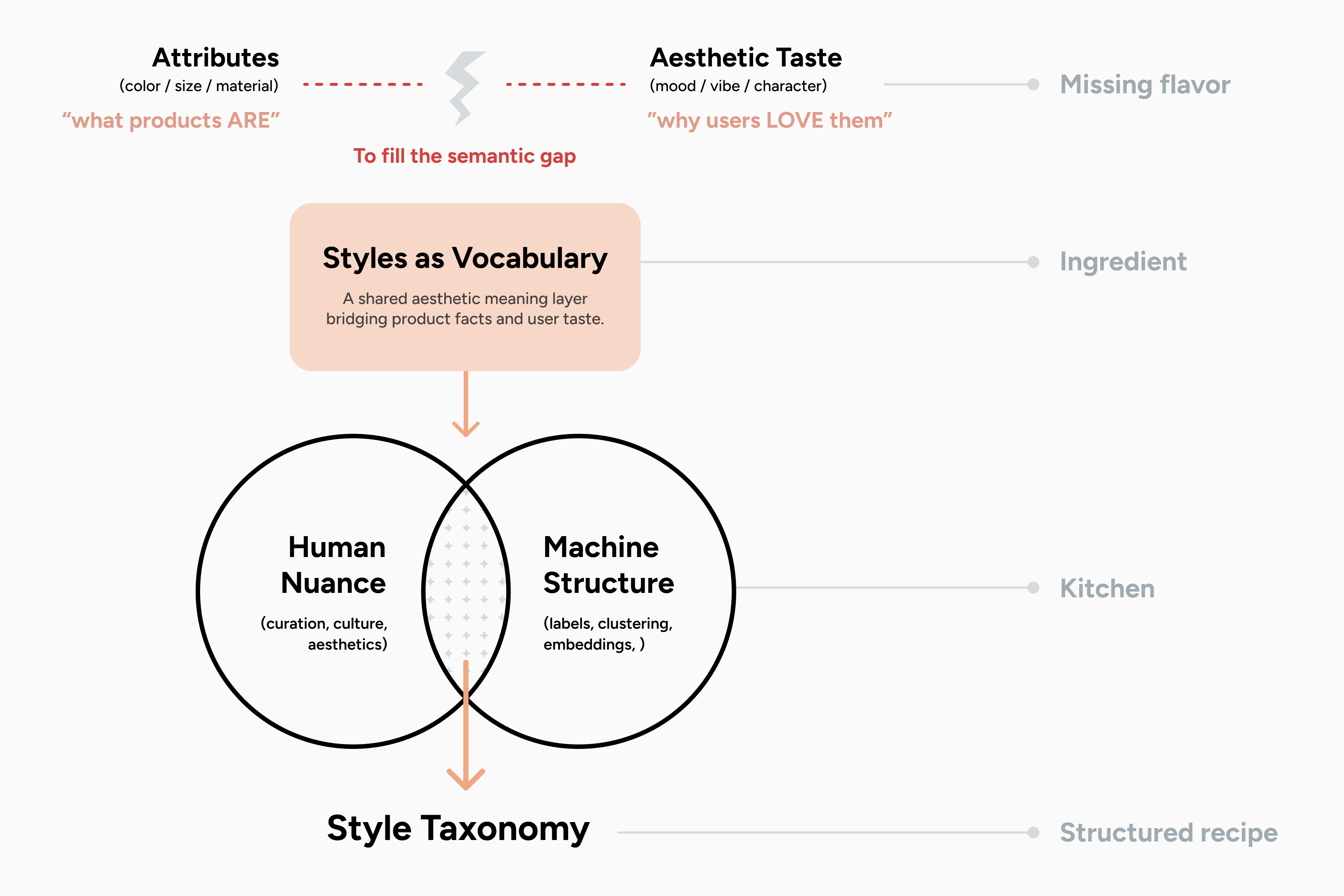
Style foundation & hybrid curation workflow
Defining style systematically was harder than naming aesthetics we intuitively recognized. Many products sat between aesthetics, expressed multiple styles, or had no clear stylistic anchor. Style is inherently fluid.
Some styles like "Streetwear" worked in one domain but didn't translate to others. Creating separate style systems per category would have solved classification quickly but created operational complexity and confused users.
We focused on Fashion and Home & Living, where style mattered most for user decisions and where choice overload was highest. These had the visual diversity and volume we needed.
Unlike concrete attributes such as color or material, style carries cultural, aesthetic, and emotional meaning. Wabi-sabi, for example, requires curatorial interpretation, not just visual pattern recognition.
This required both human insight and system logic.
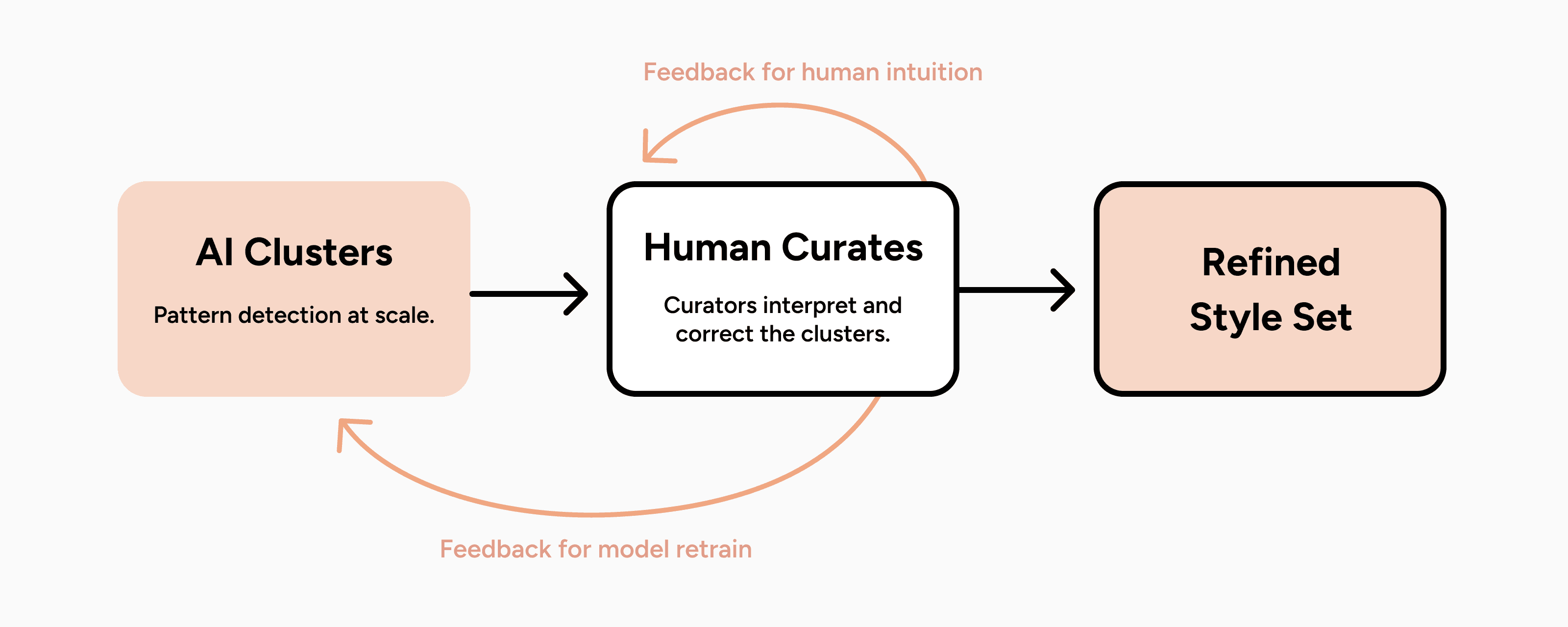
I drove a hybrid curation workflow with three components:
AI for scale: Clustering models scanned thousands of products and generated preliminary aesthetic groupings for curator review.
Human for context: Curators refined these groups by clarifying terminology, resolving overlaps, and aligning styles with Pinkoi’s brand.
Feedback as learning: Low-confidence classifications were flagged for human review, improving model accuracy and curatorial judgment over time.
The curation team and I created an initial set of 53 style classes and human-labeled datasets for each. After multiple rounds of calibration and validation, we evaluated each style using two dimensions: Breadth of representation and Accuracy of fit.
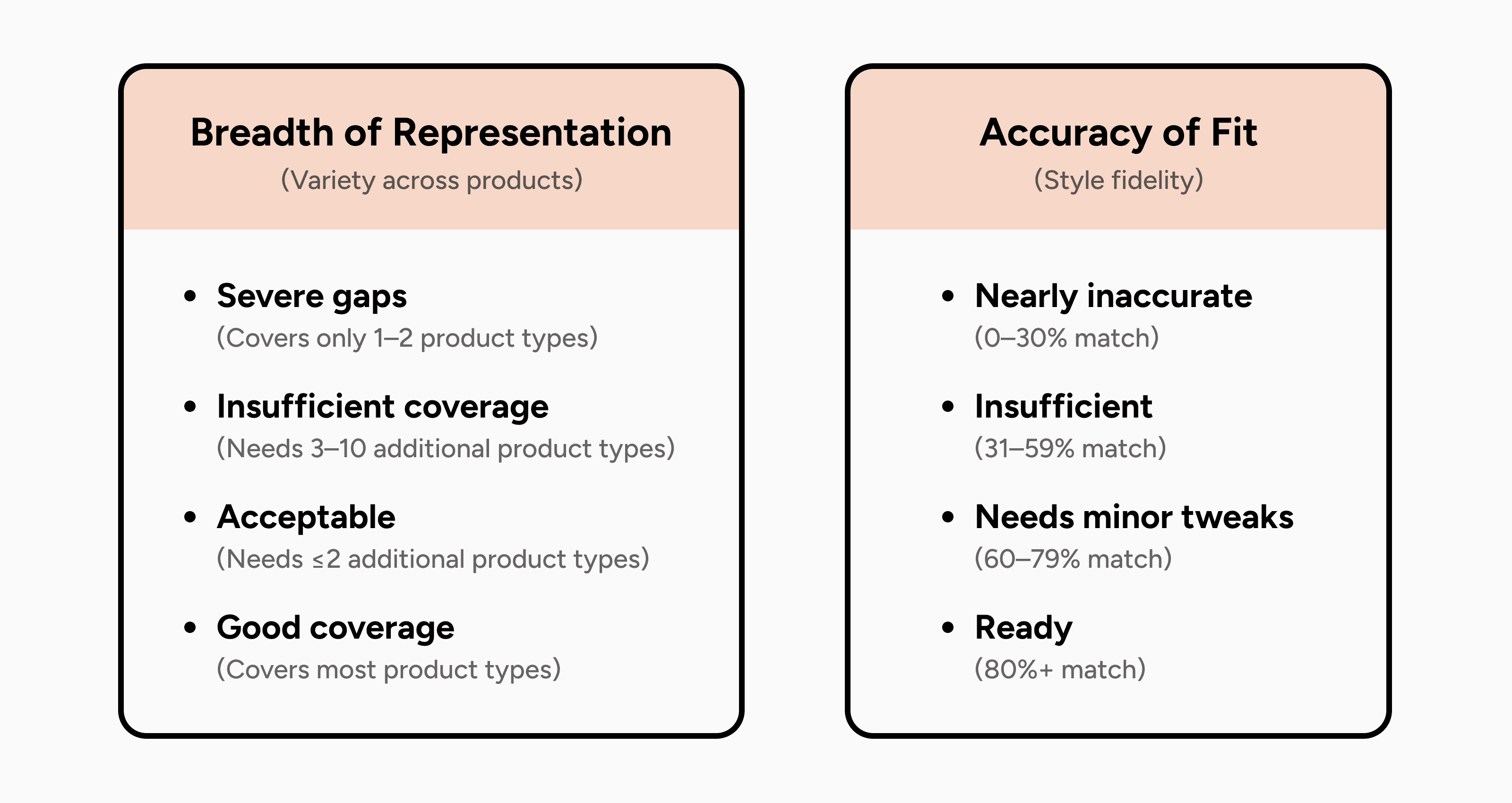
Through this human–machine calibration, we refined the taxonomy from 53 → 37 styles. Before launching to users, we confirmed each style had 1,000+ products, enough for exploration without losing coherence.
This taxonomy became the foundation for style-based discovery.
Bringing style to users: the MLP approach
With the taxonomy ready, the question was: what's the smallest user-facing expression that could prove value quickly?
Style tags were that Minimum Lovable Product: a simple pilot that let users experience style-driven discovery and worked perfectly for gift-finding, one of Pinkoi's highest-value use cases.
Early user behavior validated the approach: users explored more deeply, responded to stylistic framing, and recognized style as a meaningful lens for navigating Pinkoi's inventory.
This defined our roadmap:
Phase 1: Style → Shop by Style
Phase 2: Occasion → Shop by Occasion
Future: Mood, aesthetic, persona-based discovery
These phases created a blueprint for how adaptive curation could evolve.
While my role concluded in 2024, the blueprint was designed for ongoing iteration. We didn't have to choose between brand consistency and user relevance. We built a foundation designed to strengthen both.
A final note
I led the vision, and it came to life through teammates across product, design, curation, engineering, research, and data. Grateful to have worked with teams who cared as much about getting it right as I did.